The Customer Support Scaling Problem
As a business grows, its customer service team inevitably faces a scaling crisis. Increased traffic brings an avalanche of inquiries: questions about pricing, product features, order statuses, appointment requests, and refund policies.
While revenue scales, the human capacity to answer these repetitive questions does not. Hiring more agents for every additional hundred tickets is financially unsustainable. Simultaneously, modern consumers have zero tolerance for waiting. According to HubSpot research, the vast majority of consumers rate an "immediate" response as essential when they have a customer service question.
This tension—increasing volume versus limited human capacity—has made conversational AI for customer service the definitive solution for modern businesses. By automating the repetitive elements of the customer journey, businesses can respond instantly while allowing their human agents to focus entirely on conversations that demand genuine judgment, empathy, and expertise.
Quick Answer: What should businesses automate?
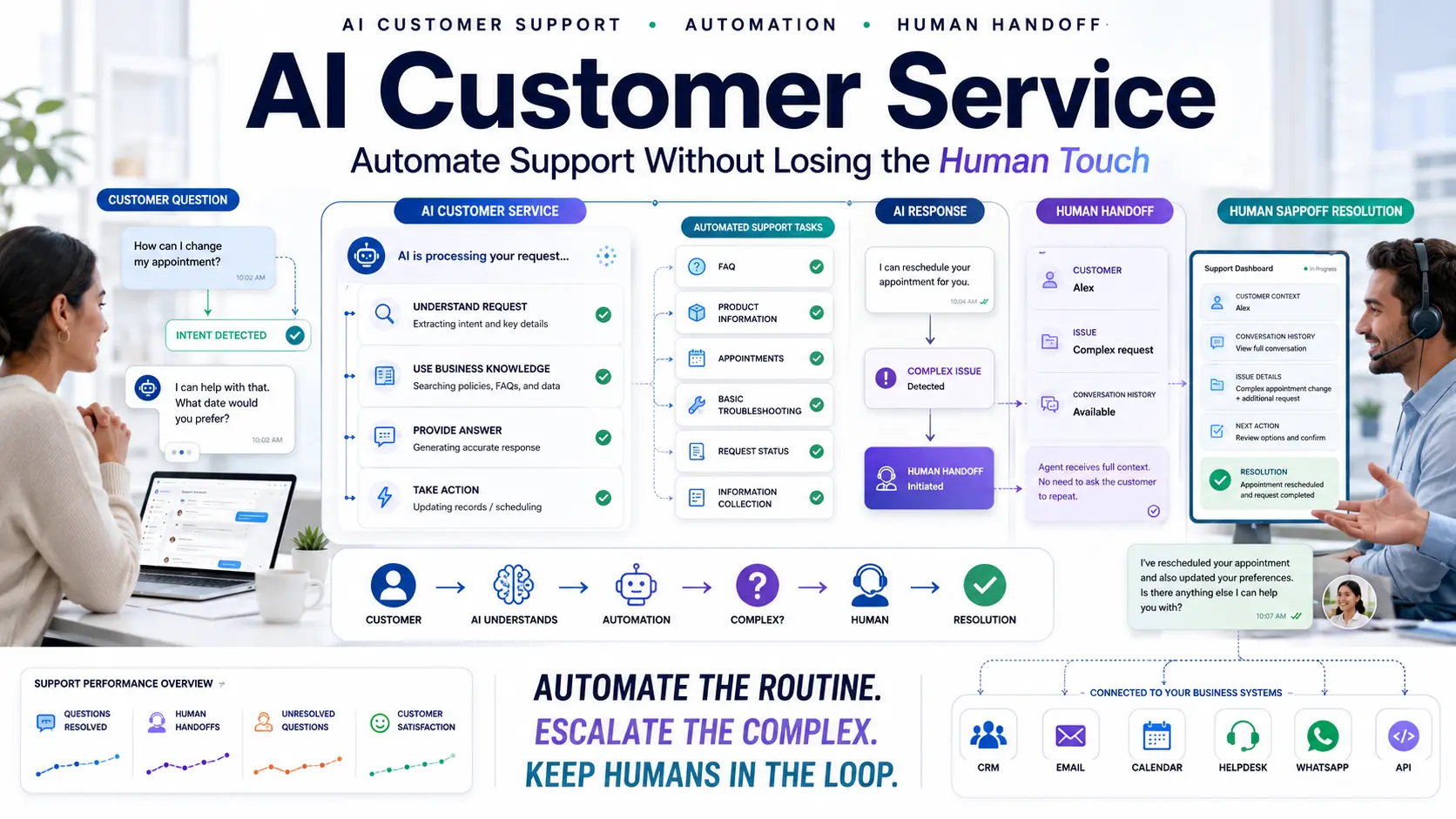
Conversational AI can automate repetitive customer-service tasks such as answering FAQs, providing business information, scheduling appointments, performing basic troubleshooting, and routing enquiries. However, human agents should always remain involved for complex complaints, highly sensitive issues, unusual edge cases, and high-value sales opportunities. The goal is to use AI to handle ticket volume while reserving human intelligence for complexity.
What Is Conversational AI for Customer Service?
Conversational AI refers to technologies—like advanced AI chatbots and virtual assistants—that use Natural Language Processing (NLP) to understand what a customer is asking and respond dynamically.
Unlike older, rule-based chatbots that forced users to click strict menus ("Press 1 for Sales"), conversational AI understands open text. Furthermore, a business-grade knowledge-based AI assistant restricts its answers specifically to your company's proprietary documents, ensuring it never provides incorrect or off-brand information. Crucially, these systems include built-in human handoff capabilities, meaning they can seamlessly transfer the chat to a live agent when needed.
Why Traditional Customer Service Is Hard to Scale
Traditional support relies on a linear formula: one customer question equals one human response.
- Repetitive Enquiries: Up to 70% of inbound tickets are the exact same 10-15 questions repeated daily.
- Agent Burnout: Highly trained agents waste hours copy-pasting the same answers to simple policy questions, leading to fatigue and high turnover.
- Long Response Times: Because agents are bogged down by simple questions, customers with urgent, complex problems are forced to wait in long queues.
- Rising Support Costs: Attempting to solve volume problems by simply adding more headcount rapidly diminishes profit margins.
As Gartner frequently highlights, service organizations cannot hire their way out of increasing ticket volumes; automation is a fundamental necessity.
What Customer Service Tasks Can AI Automate?
The secret to successful implementation is drawing a hard line between what the machine should do and what humans should do.
| Customer Service Task | AI Automation Capability | Human Involvement Needed? |
|---|---|---|
| FAQs (Pricing, Policies) | Yes (Full) | Sometimes (if edge case) |
| Business Information (Hours, Location) | Yes (Full) | Rarely |
| Appointment Booking | Yes (via Integration) | Sometimes (if reschedule required) |
| Product Information & Recommendations | Yes (Full) | Sometimes (Custom requests) |
| Order / Status Updates | Depends on Integration | Sometimes |
| Basic Troubleshooting | Yes (Step-by-step) | Escalation required if it fails |
| Complex Complaints / Anger | Limited | Yes (Immediate) |
| Highly Sensitive Personal Issues | Limited | Yes (Mandatory) |
| High-Value Enterprise Customers | Assistive / Lead Capture | Often (Account Management) |
| Unusual / Undocumented Requests | Limited | Yes (Investigation) |
By automating the top six categories, businesses typically eliminate 60% to 80% of their total inbound ticket volume, saving hundreds of hours weekly. For more details on these workflows, refer to our comprehensive guide on AI Customer Support.
What Should Businesses Keep Human?
The biggest mistake executives make is assuming AI can, or should, handle 100% of customer interactions.
AI handles volume. Humans handle complexity.
- Complex Complaints: If a shipment has been lost three times and the customer is furious, an AI cannot offer genuine empathy or authorize a special exception. A human must step in to salvage the relationship.
- Sensitive Situations: Legal matters, medical emergencies, or severe financial hardships require human nuance, judgment, and emotional intelligence.
- Complex Negotiations: AI can qualify a lead, but closing a $100,000 enterprise software deal requires a human Account Executive building trust over multiple calls.
- Unusual Edge Cases: If a customer asks a highly specific question that is not covered in your business documentation, the AI should seamlessly escalate rather than hallucinating an answer.
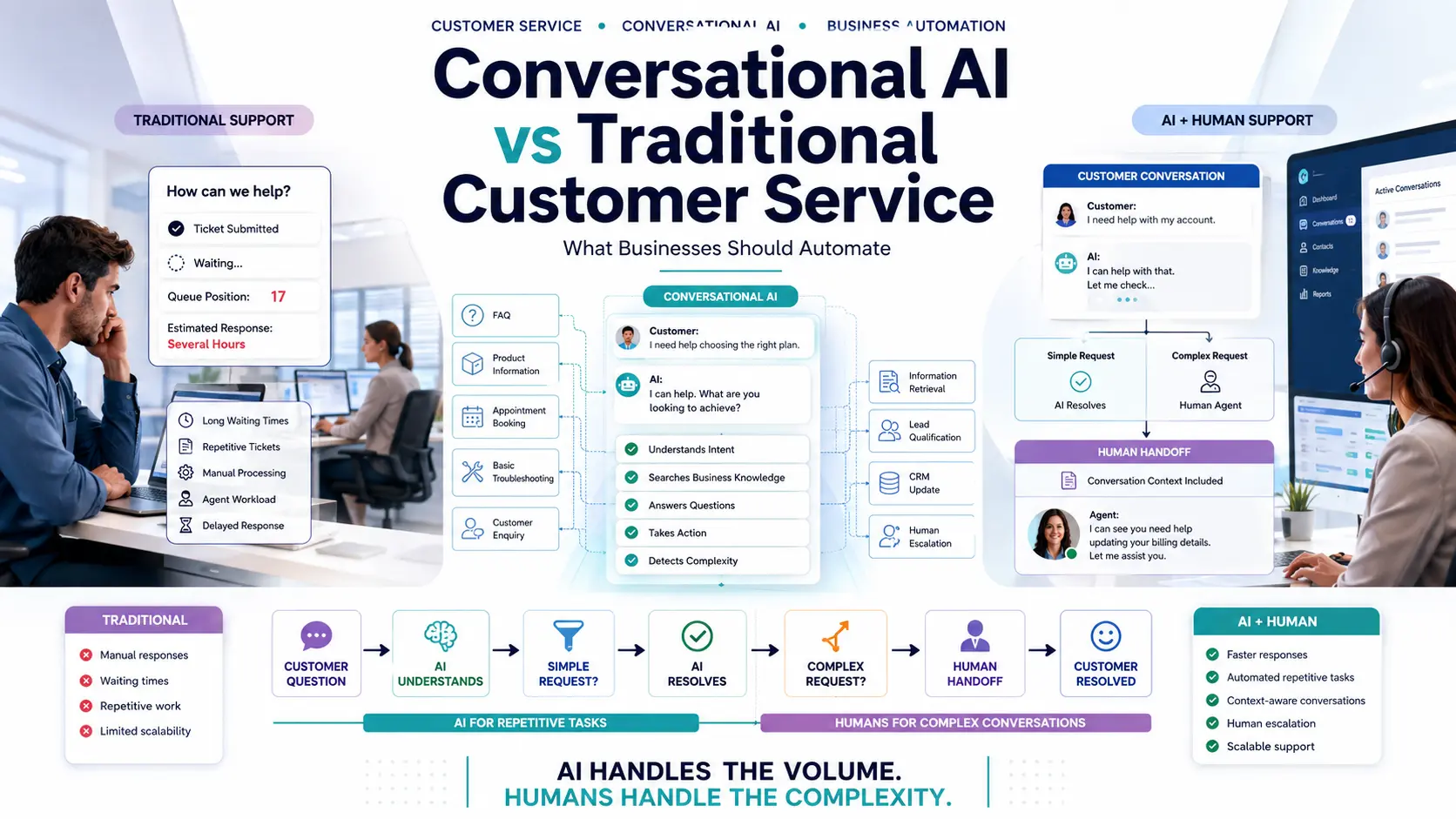
Conversational AI vs Traditional Customer Service
How do these two models compare fundamentally?
| Attribute | Traditional Support (Humans Only) | Conversational AI Support |
|---|---|---|
| Response Time | Minutes to Hours. | Milliseconds (Instant). |
| Availability | Business hours, requires shift work. | 24/7/365 without breaks. |
| Scalability | Poor. 1 agent = 1-3 concurrent chats. | Infinite. 1 AI = 10,000+ chats. |
| Repetitive Tasks | Causes fatigue and high turnover. | Handles them flawlessly. |
| Human Empathy | High capability for nuance. | Simulated; lacks real emotional intelligence. |
| Complex Problem Solving | Excellent at lateral thinking. | Limited strictly to provided knowledge base. |
| Consistency | Varies based on agent training and mood. | 100% consistent every time. |
| Operating Cost | High (Salaries, benefits, turnover). | Low (SaaS Subscription). |
The Best Approach: AI + Human Customer Service (Hybrid Model)
The goal is not to choose between AI and humans. The goal is to build a hybrid pipeline.
to Human Agent
In this hybrid model, the AI acts as a highly efficient triage nurse. It cures the minor ailments instantly and prepares the complex cases for the specialist doctor (the human agent). This completely nullifies the "AI replaces humans" fear—instead, AI makes human jobs vastly more strategic.
How Conversational AI Handles a Customer Conversation
To understand the difference between a traditional FAQ bot and conversational AI, consider this realistic interaction:
Customer: "I need help choosing the right software plan for my company."
AI: "I'd be happy to help. To give you the best recommendation, roughly how many people will be using the platform?"
Customer: "About 50 of us."
AI: "Got it. For a team of 50, our Pro Plan is usually the best fit. Are you primarily looking for project management features, CRM capabilities, or both?"
Customer: "Mainly the CRM to track our leads."
AI: "Perfect. The Pro Plan includes advanced CRM lead routing and pipeline analytics. Would you like me to schedule a 15-minute demo with our sales team so they can show you how it works?"
Notice the flow: Intent identified → Relevant questions asked → Recommendation provided → Next action (booking) suggested. This is true conversational automation, not just dropping a link to a pricing page.
How AI Knows When to Escalate to a Human
A crucial component of any AI deployment is defining the rules for human escalation. The AI should trigger a transfer if:
- Explicit Request: The customer types "speak to a human" or "let me talk to an agent."
- Knowledge Gap: The AI searches its provided documents and cannot find an answer. It should say, "I don't have that specific information, let me connect you with an expert," rather than guessing.
- Sentiment Analysis: Advanced AI can detect anger, frustration, or profanity in the text and instantly route the conversation to a senior manager.
- High-Value Actions: If a user requests to cancel a large enterprise contract, the AI shouldn't just process it; it should route to a retention specialist.
Good AI systems, as noted by Salesforce, are invisible when they work, and humble enough to step aside when they don't.
Can Conversational AI Qualify Leads and Book Meetings?
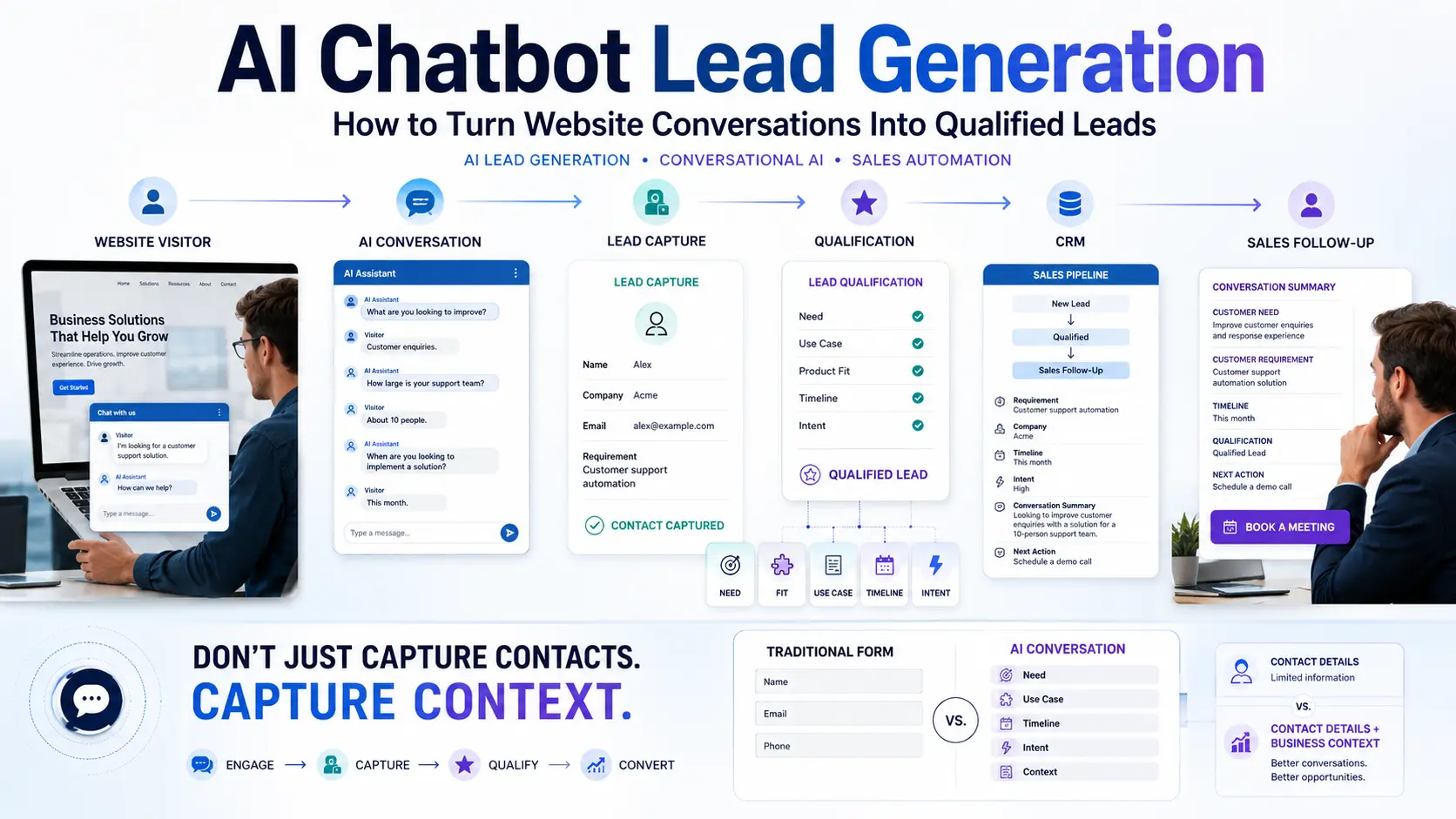
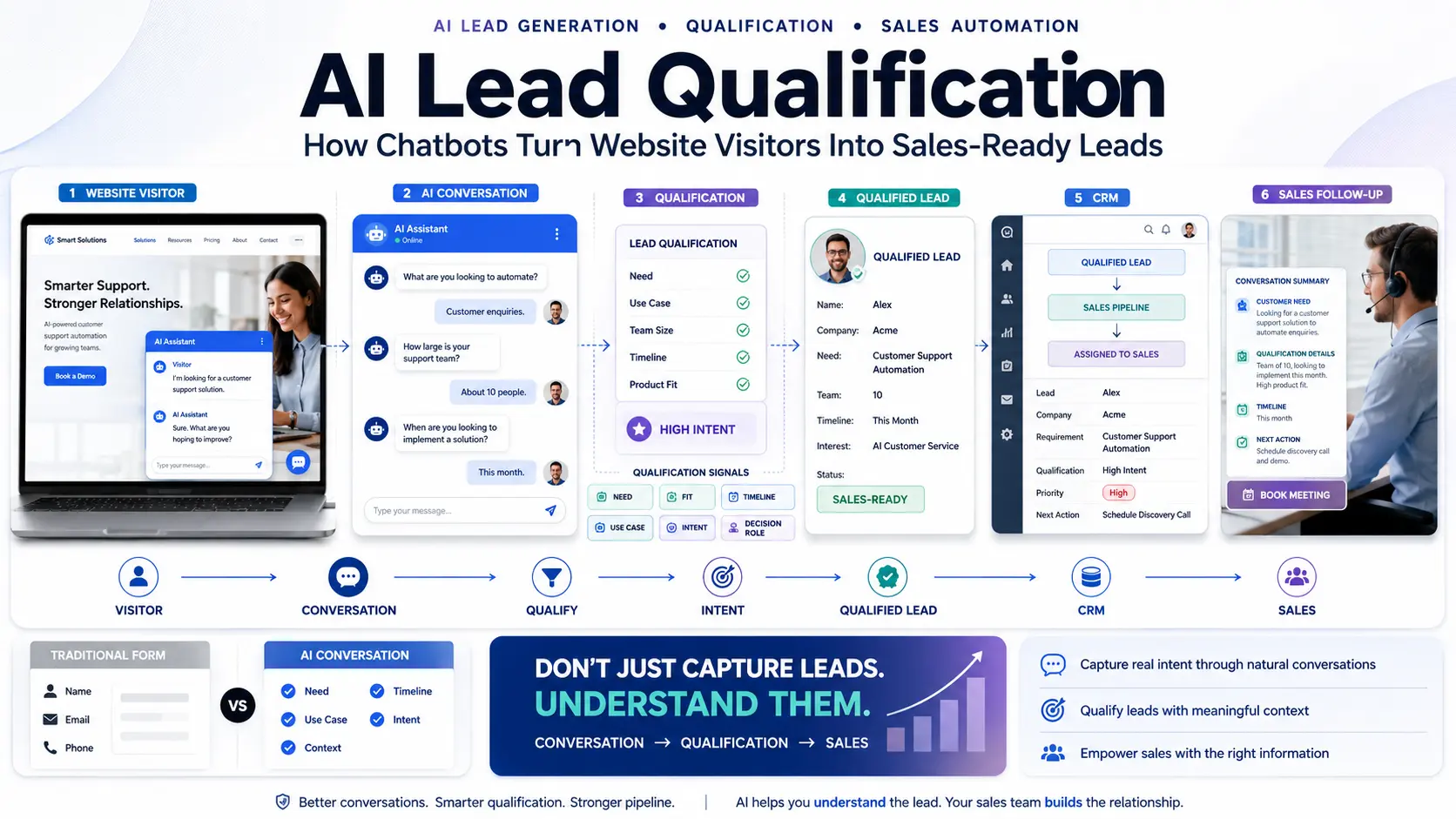
Yes. While customer support is about resolving issues, sales is about intent. An AI chatbot can easily transition from a support assistant into a lead generation tool.
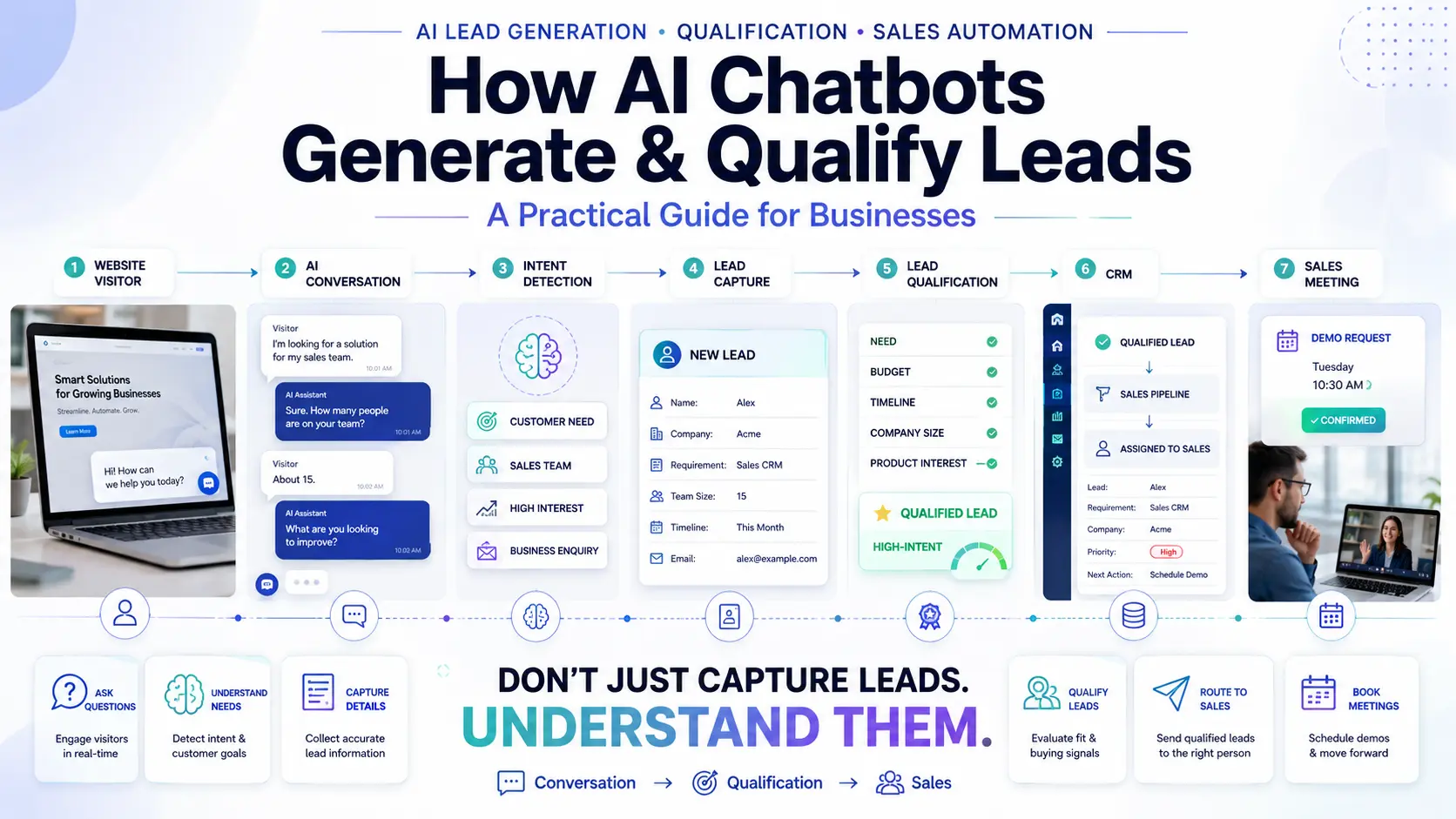
Conversation → Buying Intent Detected → Qualification Questions → Calendar Provided → Meeting Booked → CRM Updated
For a deep dive into how AI identifies buying signals and scores prospects, see our complete guide on AI Lead Qualification and how to use website chatbots for lead generation.
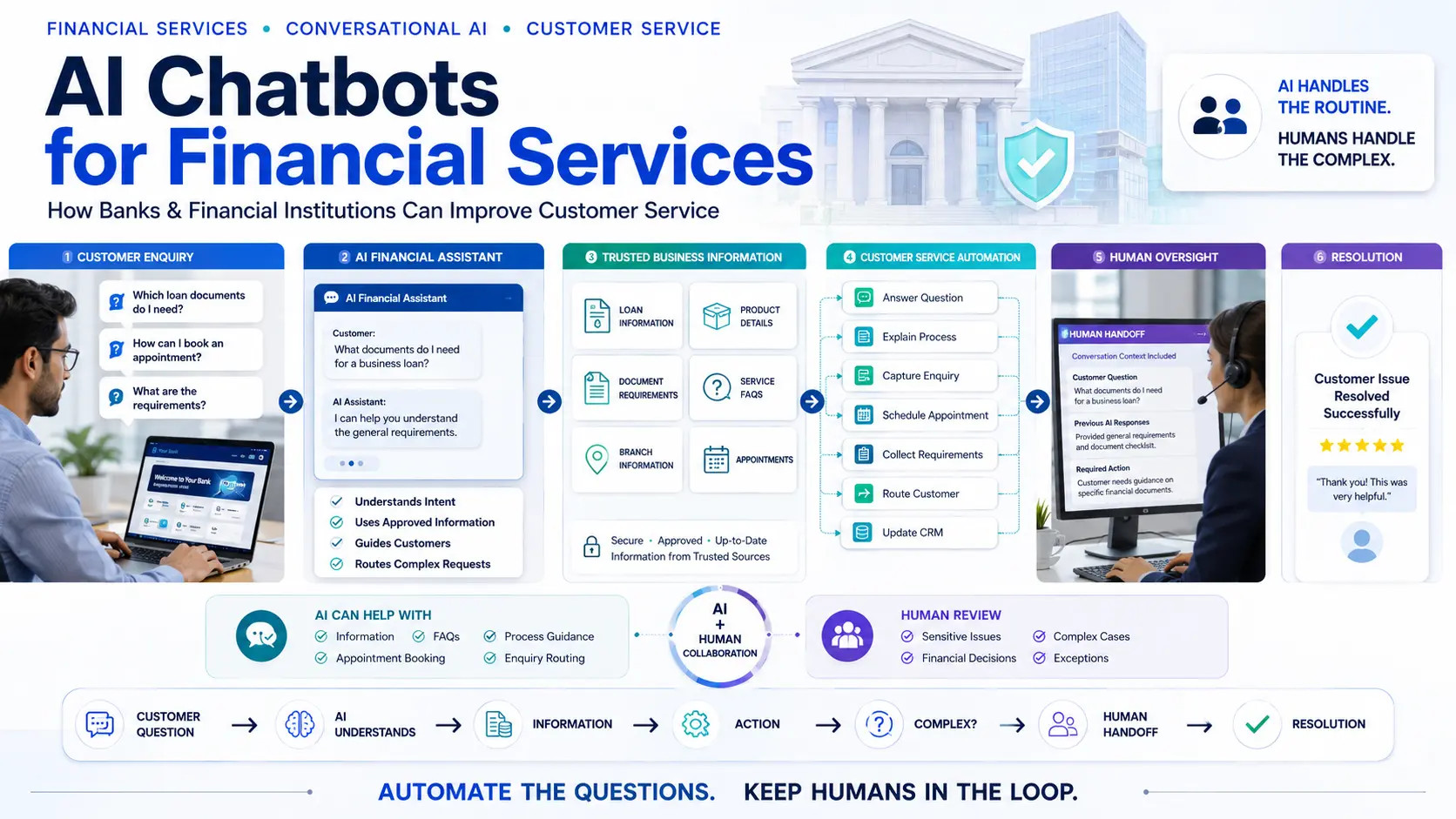
AI Customer Service for Financial Institutions
Financial services—including banks, credit unions, and insurance companies—face unique regulatory challenges.
In these environments, businesses must clearly distinguish between providing Information and providing Financial Advice.
An AI chatbot in financial services should automate:
- Explaining checking vs. savings account features
- Detailing general mortgage eligibility requirements
- Providing branch locations and opening hours
- Routing users to the correct department (e.g., fraud vs. loans)
- Scheduling appointments with loan officers
An AI chatbot must never:
- Tell a customer what stock to buy
- Guarantee a loan approval
- Handle highly sensitive transactions without secure authentication
Conversational AI Across Different Industries
The exact tasks you automate depend entirely on your vertical:
- E-commerce: Focus automation on "Where is my order?" inquiries, return policies, and personalized product recommendations based on budget.
- SaaS: Automate feature explanations, technical troubleshooting, onboarding flows, and plan comparisons.
- Healthcare: Automate clinic information, accepted insurance providers, and initial appointment triage (always escalating medical advice).
- Higher Education: Automate admissions deadlines, tuition queries, visa requirements for international students, and campus tour bookings.
- Real Estate: Automate property availability checks, capture budget/location preferences, and book property viewings.
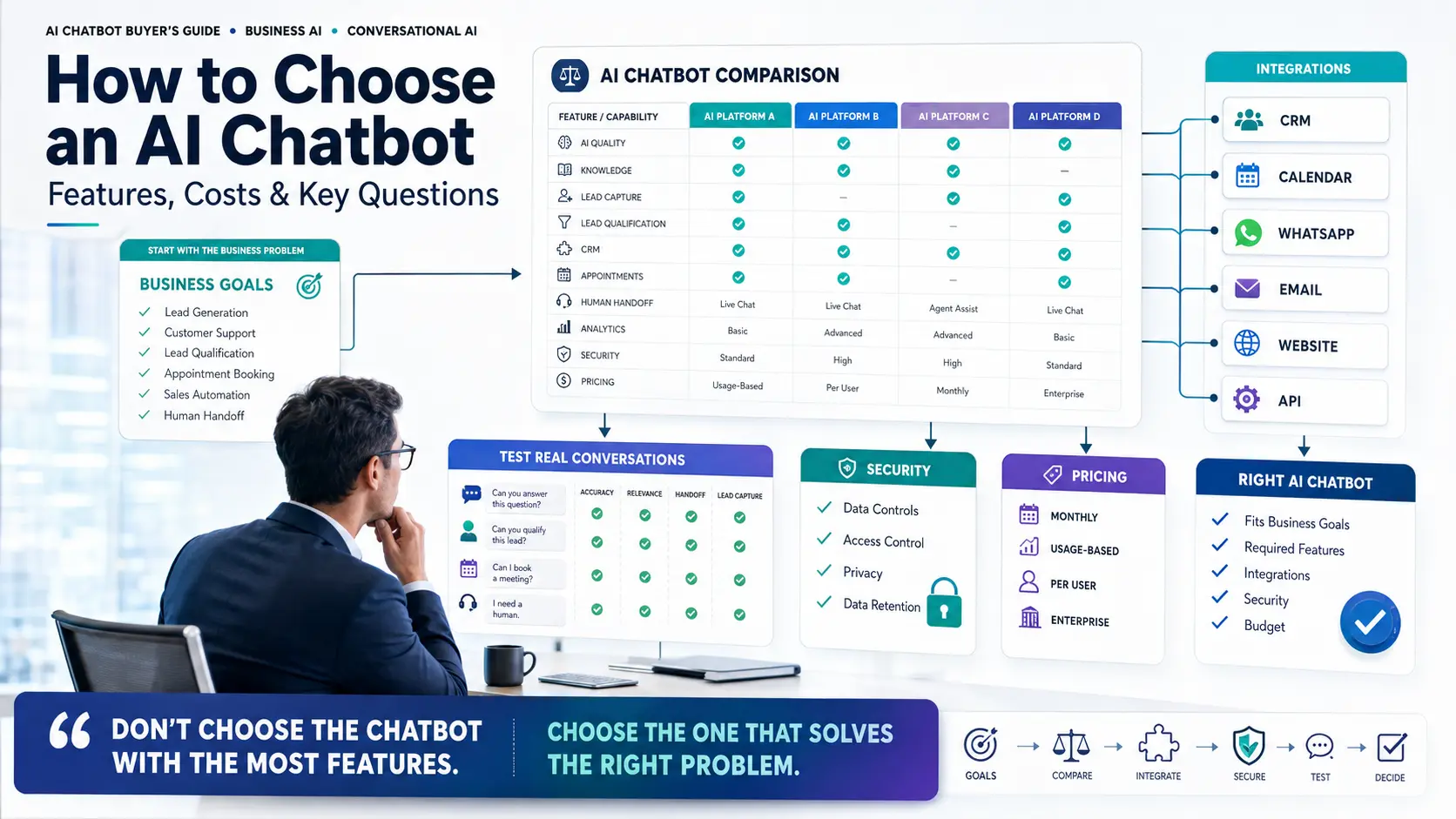
For a broader view of operational automation, explore our guide on AI chatbots for business.
How to Implement Conversational AI for Customer Service
Deploying AI successfully requires preparation. Follow this practical framework:
- Identify repetitive enquiries: Export your last 500 support tickets and categorize the most common themes.
- Build a reliable knowledge base: Gather the FAQs, PDFs, and website URLs that contain the answers to those common themes.
- Decide what AI can answer: explicitly define the boundaries of the chatbot.
- Define human escalation rules: Decide exactly when and how a live agent takes over.
- Design conversation flows: Outline how leads should be qualified if the conversation turns to sales.
- Connect business systems: Ensure data flows automatically into your helpdesk or Pre-Sales CRM.
- Test real scenarios: Run mock customer interactions to ensure the AI behaves as expected.
- Launch gradually: Deploy to 20% of traffic first to catch any edge cases.
- Monitor and improve: Review conversation logs weekly to fill gaps in the AI's knowledge base.
How to Measure AI Customer Service Performance
Tracking "number of conversations" is a vanity metric. To prove ROI, track:
- First-Contact Resolution (FCR): The percentage of queries the AI resolved without human help.
- Escalation Rate: How often the AI had to transfer to a human. (A high rate means your knowledge base is lacking).
- Support Workload Reduction: The total number of hours saved by human agents.
- Customer Satisfaction (CSAT): User ratings collected immediately after the AI interaction.
- Qualified Enquiries / Appointments Booked: For sales-focused interactions, track tangible business outcomes.
Common Conversational AI Mistakes
Automating Everything
The Problem: Forcing complex or angry customers to deal with a bot.
The Solution: Always provide a clear path to human escalation.
Poor Knowledge Sources
The Problem: The AI gives outdated or generic answers.
The Solution: Connect the AI directly to your live, constantly updated website content.
Asking Too Many Questions
The Problem: Forcing users through a 10-step qualification flow.
The Solution: Keep data collection to a maximum of 3-4 natural questions.
No Monitoring
The Problem: Launching the bot and forgetting it.
The Solution: Have a human review the transcripts weekly to improve the AI's instructions.
How Quillive Helps Businesses Automate Customer Conversations
Quillive is designed as a secure, intelligent AI Website Assistant for modern businesses.
It doesn't replace your customer service team; it acts as their front-line defense. By instantly ingesting your website content, policies, and FAQs, Quillive can:
- Handle 80% of repetitive customer enquiries instantly
- Capture customer requirements and qualify leads
- Book appointments directly onto your calendar
- Seamlessly hand complex conversations over to your human agents
- Connect all conversation data directly into your Lead Management CRM
Quillive ensures that every visitor gets an immediate answer, while your team gets their time back.
Frequently Asked Questions
What is conversational AI in customer service?
It is the use of natural language processing to understand customer questions and resolve issues automatically via chat or voice.
What is AI customer service?
Using artificial intelligence to automate support tasks like answering FAQs, routing tickets, and qualifying leads without human intervention.
Can AI replace customer service agents?
No. AI handles high-volume, low-complexity tasks, freeing human agents to handle high-value, complex, and emotionally sensitive cases.
What customer-service tasks can AI automate?
FAQs, business information retrieval, appointment booking, basic troubleshooting, and order status requests.
When should AI transfer a customer to a human?
During complex complaints, when sensitive information is involved, if the customer is frustrated, or if the conversation is a high-value sales opportunity.
Is AI customer service suitable for small businesses?
Yes, it acts as a 24/7 digital employee, allowing small teams to provide enterprise-level support affordably.
How does conversational AI improve response times?
It responds instantly to thousands of concurrent users, eliminating wait queues entirely for basic requests.
Can AI chatbots handle complex customer questions?
If the exact answer is in its training data, yes. If the problem requires bespoke problem-solving, it should escalate.
Can AI customer service integrate with CRM?
Yes, tools like Quillive sync directly with systems like QuillCRM and Salesforce to log transcripts automatically.
Can AI qualify leads?
Absolutely. It can dynamically ask vetting questions (budget, timeline) and score the lead's intent.
Can AI book meetings?
Yes, by integrating with calendar tools, it can show availability and schedule consultations natively.
What is the difference between AI customer service and live chat?
Live chat requires a human typing responses. AI generates responses autonomously and instantly.
Is conversational AI suitable for financial institutions?
Yes, for information retrieval (like branch hours or loan eligibility), provided it is restricted from giving direct financial advice.
Are AI chatbots safe for financial services?
Yes, enterprise AI platforms use strict data privacy controls and RAG technology to prevent hallucinations.
How do you measure AI performance?
Through first-contact resolution rates, escalation rates, customer satisfaction scores, and hours saved by human agents.
Why do some AI chatbots fail?
Often due to attempting to automate too much, using outdated knowledge bases, and lacking clear human escalation paths.
What industries use conversational AI?
E-commerce, SaaS, Healthcare, Real Estate, Education, and Finance are the biggest adopters due to high query volume.
Can AI speak multiple languages?
Yes, modern AI automatically detects the user's language and translates responses in real-time.
Does AI customer service sound robotic?
No, advanced NLP allows the AI to converse fluently and adopt your brand's unique tone of voice.
How long does it take to deploy?
Depending on the platform, customized AI assistants can be trained on your website data and deployed in days.
Conclusion
The ultimate goal of conversational AI for customer service is not to remove humans from customer interactions. The goal is to remove unnecessary manual work.
When determining your strategy, use this simple framework:
- REPETITIVE → AUTOMATE
- COMPLEX → ASSIST
- SENSITIVE → ESCALATE
- HIGH-VALUE → HUMAN + AI
By allowing AI to handle the volume of everyday questions, businesses empower their human teams to provide higher quality, deeply empathetic support where it truly matters.
With solutions like Quillive, transitioning to a fast, efficient, hybrid customer service model has never been easier.

Quillnext Team
The Quillnext Team builds advanced conversational AI solutions that help businesses automate customer support, capture leads, and scale operations efficiently.
Visit Quillnext