The Customer Service Challenge in Finance
Financial institutions are under immense pressure to deliver flawless customer experiences. Every day, banks, lenders, and insurance companies receive thousands of enquiries regarding banking products, loan applications, credit cards, required documents, branch information, and service processes.
Managing this volume presents severe operational challenges. Customer service teams face high enquiry volumes composed largely of repetitive questions. Managing multiple customer channels while handling highly sensitive information causes significant agent workload. As customer expectations for instant answers continue to rise, relying purely on human staff for every basic question is no longer viable.
AI chatbots for financial services offer a robust solution. By automating appropriate interactions, financial institutions can instantly resolve routine questions, ensuring that human agents remain available for the complex, sensitive, and high-value situations that truly require their expertise.
Quick Answer: How do financial chatbots help?
An AI chatbot for financial services helps banks and institutions automate customer support by instantly answering common questions, providing product information, guiding customers through application processes, scheduling appointments, and accurately routing enquiries. Crucially, while AI is highly effective at delivering information and capturing preliminary requirements, it escalates complex cases to human agents. AI should never independently make sensitive financial decisions without appropriate human controls and regulatory oversight.
What Is an AI Chatbot for Financial Services?
In the context of financial institutions, an AI chatbot is an advanced conversational AI application designed specifically to handle customer service and enquiry workflows.
Unlike basic rule-based bots, these tools utilize deep financial knowledge bases (your institution's approved documentation, policies, and FAQs) to converse naturally with users. They feature secure business integrations that allow them to book appointments or log data into a CRM, and they possess robust human handoff capabilities to ensure customers can reach a live agent whenever necessary.
Why Financial Institutions Are Exploring AI Customer Service
The financial sector is rapidly adopting automation due to a convergence of compounding operational pressures.
- High Enquiry Volumes: Thousands of customers asking for branch hours or generic loan requirements daily.
- Long Response Times: Simple queries clog the queues, causing long wait times for customers with critical issues.
- Difficulty Scaling Support: Hiring and training financial support staff is expensive and time-consuming.
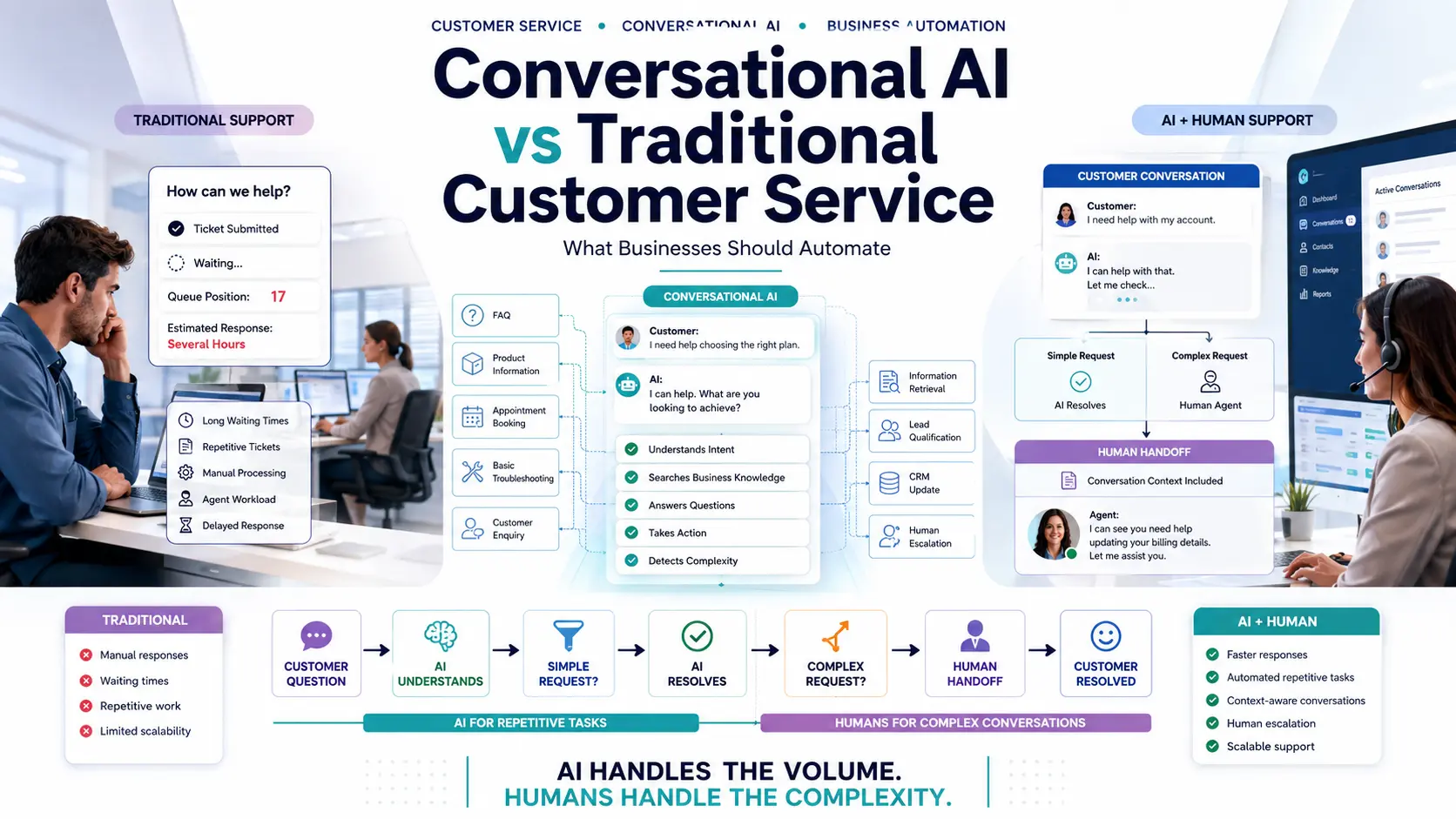
The fundamental philosophy driving this adoption is simple: AI handles volume and repetitive work, while humans handle complexity and judgment. By applying conversational AI to traditional customer service, institutions achieve scale without sacrificing quality.
How Banks and Financial Institutions Can Use AI Chatbots
Identifying exactly what to automate is critical. Here is a breakdown of common use cases and the appropriate level of human involvement:
| Use Case | What AI Can Help With (Automated) | Human Involvement Needed |
|---|---|---|
| Product Information | Explain checking, savings, and credit features | Complex product comparisons |
| Loan Enquiries | Explain general eligibility and rates | Application decisions / Underwriting |
| Credit Cards | Explain benefits, limits, and requirements | Sensitive fraud cases / disputes |
| Insurance | Answer basic policy and service questions | Complex claims assessment |
| Branch Information | Provide locations, routing, and hours | Unusual branch exceptions |
| Appointment Booking | Schedule branch or virtual meetings | The actual financial consultation |
| Document Requirements | List required ID and income proofs | Exception handling for rare documents |
| Application Status | Provide basic status (requires API integration) | Explaining rejections / Escalations |
| General FAQs | Instantly answer common website questions | Highly unusual or unscripted questions |
| Customer Routing | Identify intent and route to correct department | Human resolution of the ticket |
AI Chatbots for Banking Customer Service
In retail and commercial banking, customers frequently require rapid access to data. A banking chatbot can manage queries regarding product features, branch locations, and document requirements.
However, banks must maintain a strict boundary between GENERAL INFORMATION (which AI can serve freely) and AUTHENTICATED ACCOUNT ACTIONS (which requires secure infrastructure). An informational website chatbot cannot and should not attempt to process wire transfers or alter account details without deep, secure backend integration and explicit customer authentication.
AI Chatbots for Loan and Credit Enquiries
Applying for a loan is often daunting. Conversational AI acts as a helpful preliminary guide, helping users understand loan types, general eligibility criteria, timelines, and required documents before they speak to a loan officer.
Customer: "I’m looking for a business loan."
AI: "I can help you understand our available options. Are you looking for working capital, equipment financing, or another type of business loan?"
Customer: "Working capital, roughly $50,000."
AI: "For working capital, we offer a Business Line of Credit that might suit your needs. To apply, you'll generally need two years of tax returns and a business checking account. Would you like me to schedule a call with a commercial lending specialist to discuss your specific situation?"
The AI successfully collects preliminary information, provides value, and routes the enquiry—without overstepping and making a final lending decision.
AI Chatbots for Insurance Customer Service
Insurance companies utilize AI to answer coverage questions, outline renewal processes, provide general claims guidance, and request missing documents. While an AI can efficiently intake the initial details of a claim (e.g., date of incident, photos), the complex claims assessment and financial decisions require qualified human adjusters.
How Conversational AI Handles a Financial-Service Conversation
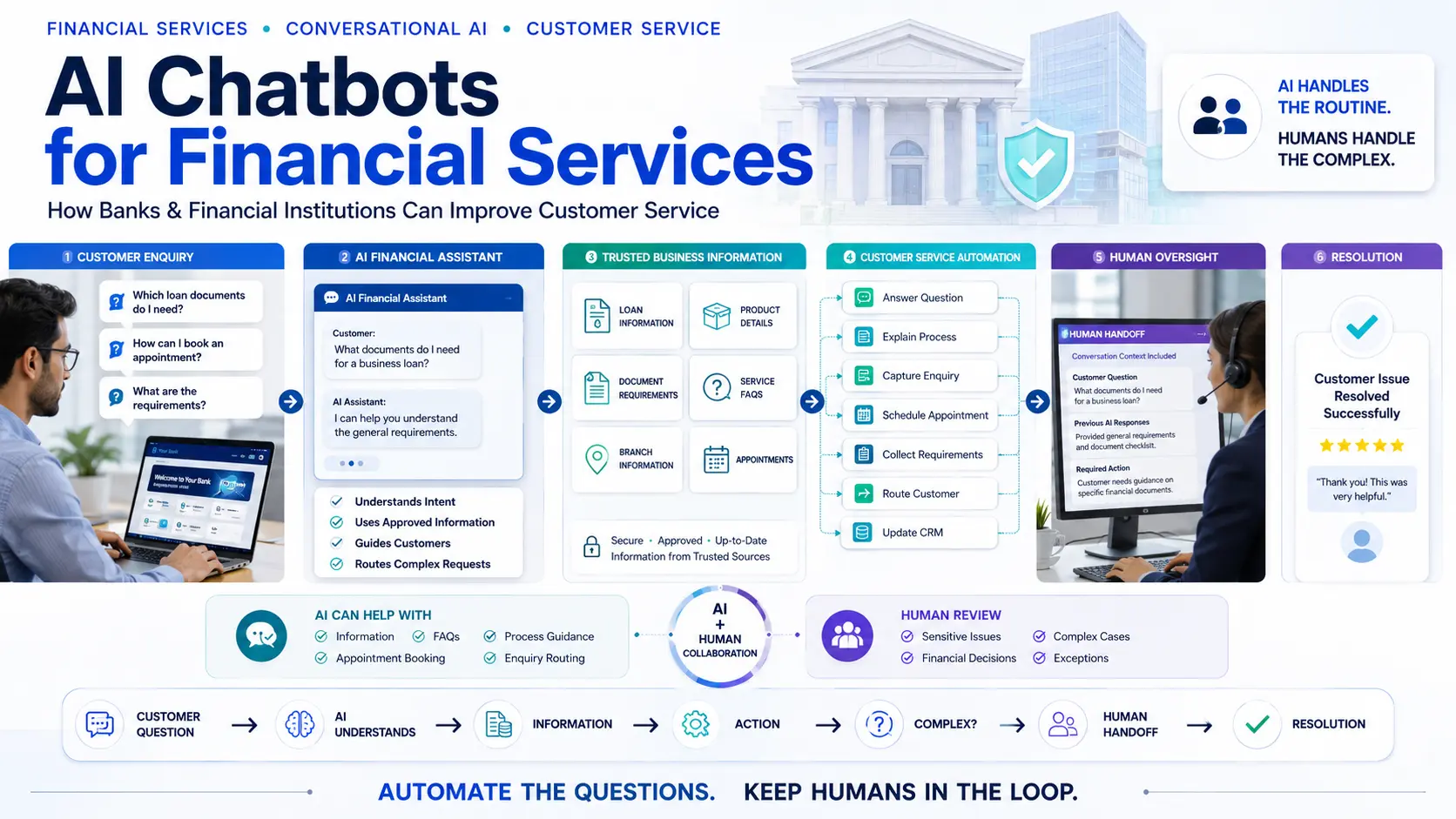
A well-architected conversational flow looks like this:
For example: A customer asks, "What documents do I need for a home loan?" The AI replies, "Here are the commonly required documents..." and immediately follows up with, "Would you like to speak with a mortgage specialist to review your specific situation?" This demonstrates helpful automation that appropriately defers to human expertise.
What Financial Institutions Should NOT Automate With AI
This is arguably the most critical component of a financial AI strategy. The core principle is: Automate information and workflows where appropriate; do not blindly automate decisions requiring expertise, judgment, authentication, or regulatory oversight.
- Final Lending Decisions: AI should not unilaterally approve or deny credit without human oversight and established underwriting algorithms.
- Financial Advice: AI must be heavily restricted from telling customers what investments to buy.
- Fraud Investigations: Suspected fraud requires human intuition and secure investigation protocols.
- Sensitive Disputes: Customers challenging severe account errors require human empathy and escalation.
- Identity Verification: Simply chatting with a bot does not verify an identity for high-risk account changes.
AI Chatbot vs Human Customer Service in Financial Services
Rather than pitting AI against humans, institutions must understand their respective strengths.
| Area | AI Chatbot | Human Agent |
|---|---|---|
| Repetitive FAQs | Excellent | Time-consuming |
| Product Information | Excellent (with reliable knowledge) | Excellent |
| Simple Enquiries | Excellent | Excellent |
| Complex Cases | Limited | Excellent |
| Empathy | Limited | Excellent |
| Sensitive Issues | Requires Escalation | Excellent |
| Scalability | High | Limited by staffing |
| Judgment | Limited | Strong |
| Human Handoff | Can initiate | Can resolve |
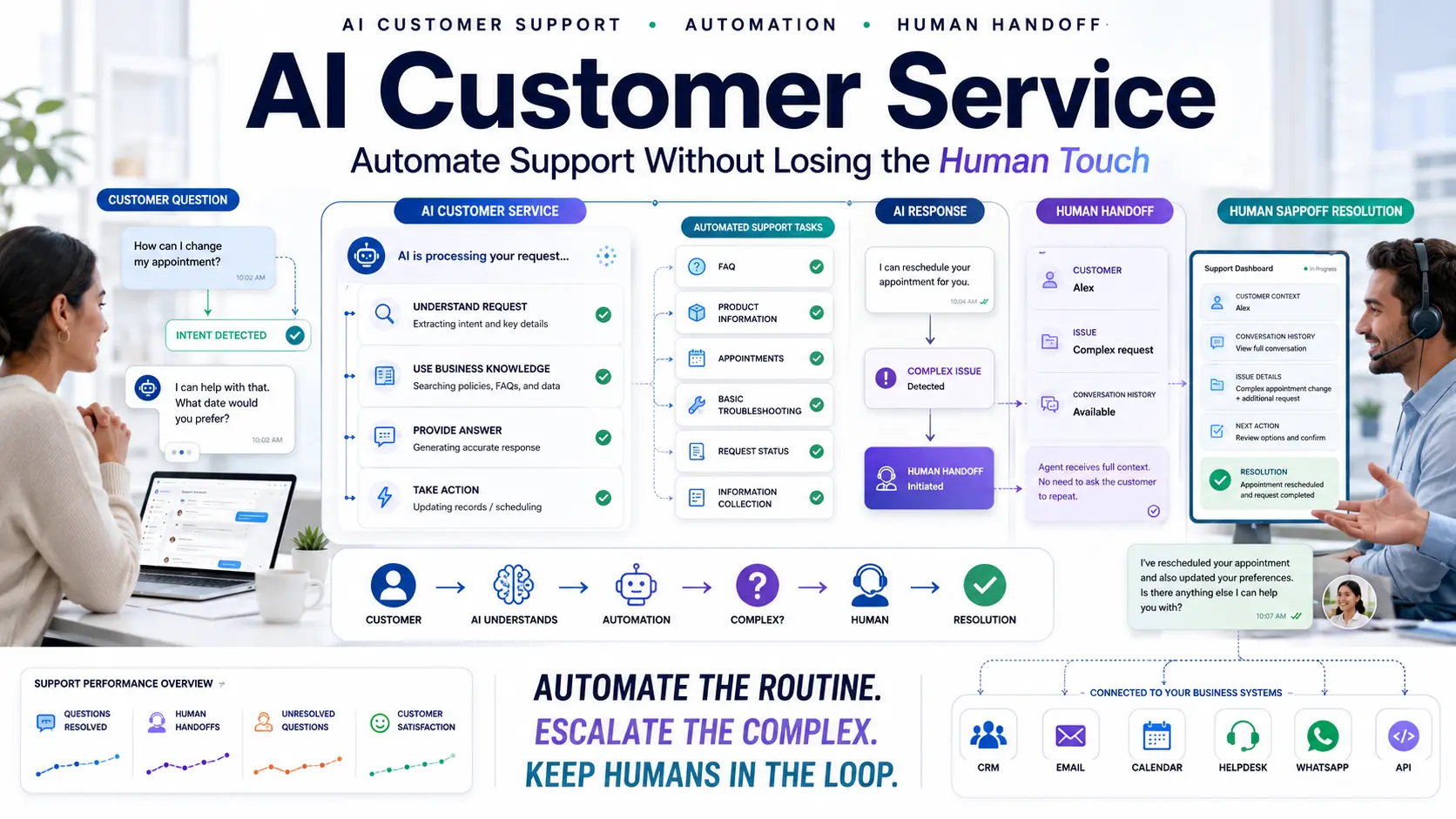
The Hybrid Model: AI + Human Customer Service
The conclusion is obvious: businesses need a hybrid approach.
Customer → AI Assistant
↳ Simple enquiry? → YES → AI resolves
↳ Simple enquiry? → NO → Human Agent
↳ Conversation context transferred
↳ Human continues
Transferring the context is vital. If a customer spends five minutes explaining their mortgage need to an AI, the human agent receiving the transfer must immediately see the transcript. The customer should never have to repeat themselves.
Security, Privacy and Human Oversight
In financial services, adopting AI requires stringent data privacy, authentication, and access control.
Financial institutions should design AI deployments around applicable security, privacy, compliance, and regulatory requirements (often guided by bodies like the Federal Reserve or CFPB). This means employing data minimization (not asking the bot to collect SSNs in an unauthenticated chat window) and maintaining complete auditability of all conversations.
How to Implement an AI Chatbot for Financial Services
Use this practical framework to ensure a secure, successful launch:
- Step 1 — Identify repetitive enquiries: Find the questions customers ask frequently on your website.
- Step 2 — Build a trusted knowledge base: Upload only officially approved and current business information.
- Step 3 — Define what AI can answer: Create clear boundaries (e.g., "Answer policy questions, but do not advise on stock purchases").
- Step 4 — Define escalation rules: Identify the exact triggers when humans must take over.
- Step 5 — Connect relevant systems: Integrate with your CRM, appointment scheduling software, and customer-service helpdesk.
- Step 6 — Test real scenarios: rigorously test normal questions, sensitive questions, and unsupported requests.
- Step 7 — Launch gradually: Start with lower-risk informational use cases before tackling deep integrations.
- Step 8 — Monitor and improve: Review conversations and outcomes continuously to refine accuracy.
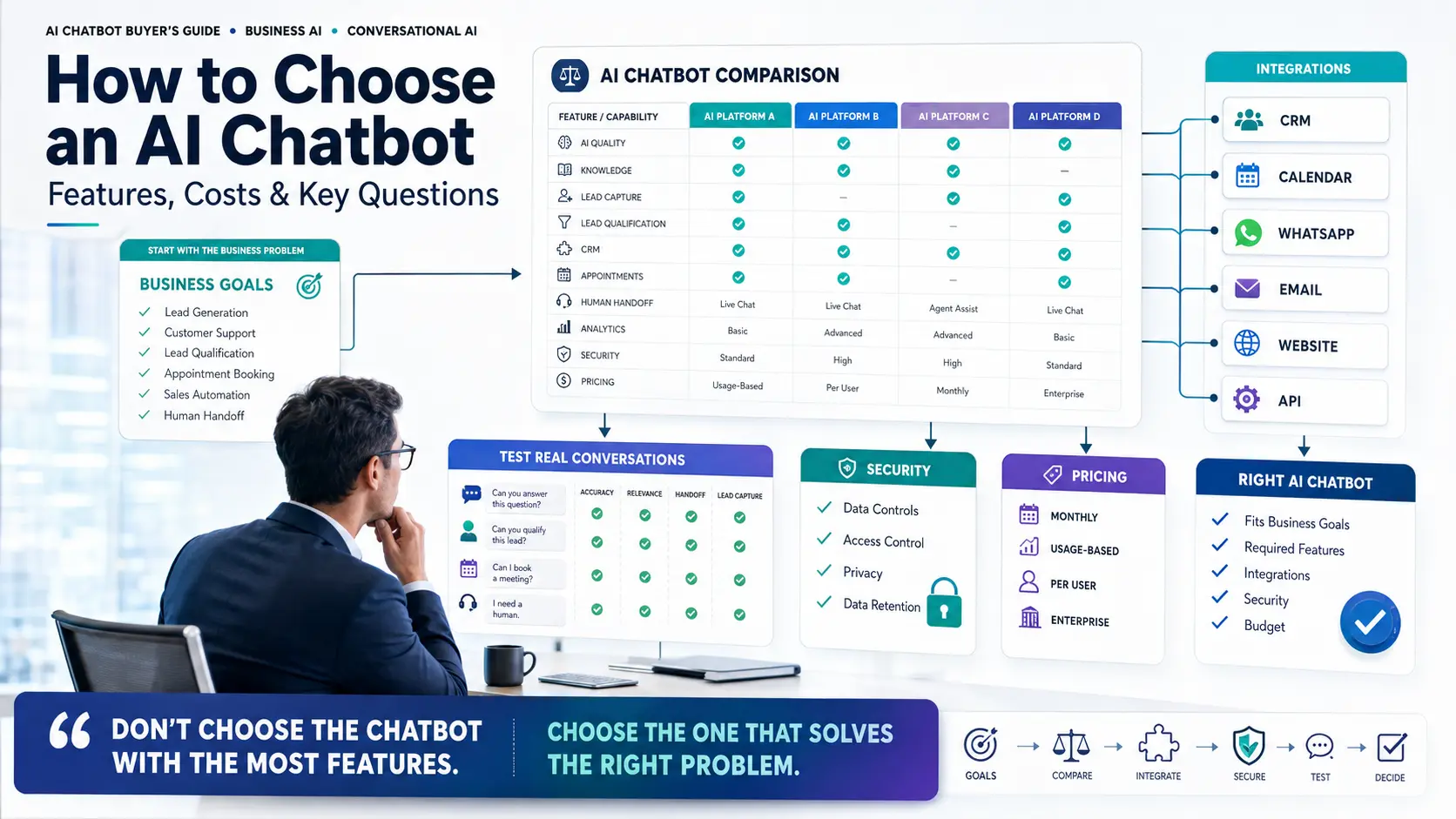
For a broader look at deployment across a business, read our guide on AI Chatbots for Business.
How to Measure AI Customer Service in Financial Services
Relying solely on "chatbot conversation volume" is not a useful success metric. It doesn't tell you if the customer was actually helped. Instead, financial leaders should track:
- Response time
- First-contact resolution rate
- Human escalation rate
- Customer satisfaction (CSAT)
- Support workload reduction
- Appointment bookings / Qualified enquiries
- Customer-service cost per interaction
Common Mistakes When Implementing Financial-Service Chatbots
- Automating everything immediately: Start with basic FAQs before complex authenticated routing.
- Using outdated information: Ensure the AI's knowledge base syncs with your live website.
- No human escalation: Always provide an "escape hatch" to a real agent.
- Poor security controls: Never request sensitive PII in public, unauthenticated widgets.
- Asking for unnecessary information: Keep qualification questions brief.
- Giving unclear answers: Program the bot to say "I don't know" rather than hallucinating.
- No testing: Have internal staff try to "break" the bot before public launch.
- No monitoring: Audit transcripts weekly to identify unhandled queries.
- Making unsupported financial recommendations: Explicitly restrict the AI from giving advice.
- Measuring the wrong KPIs: Focus on resolutions and CSAT, not just chat volume.
Can Financial-Service Chatbots Generate and Qualify Leads?
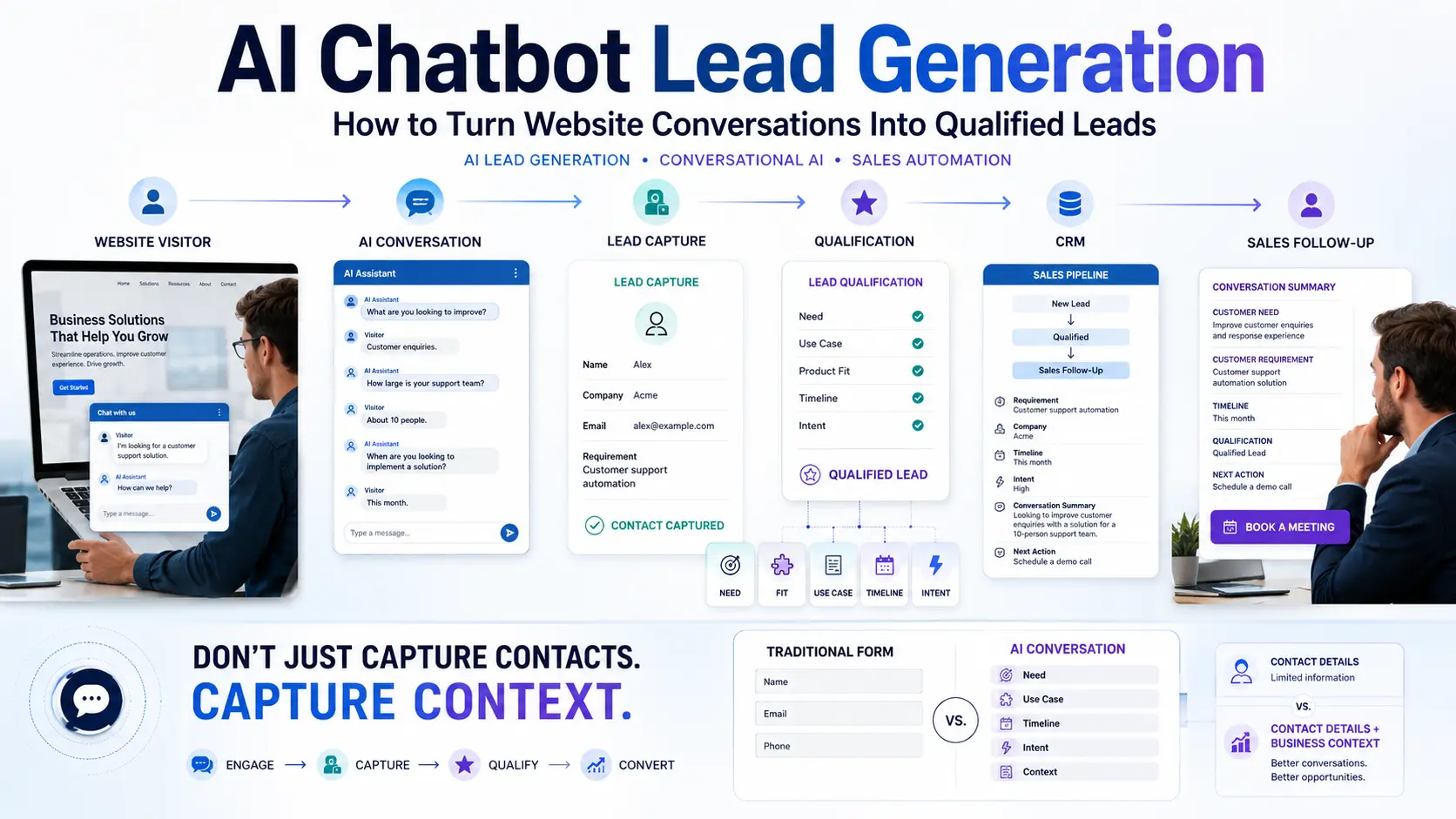
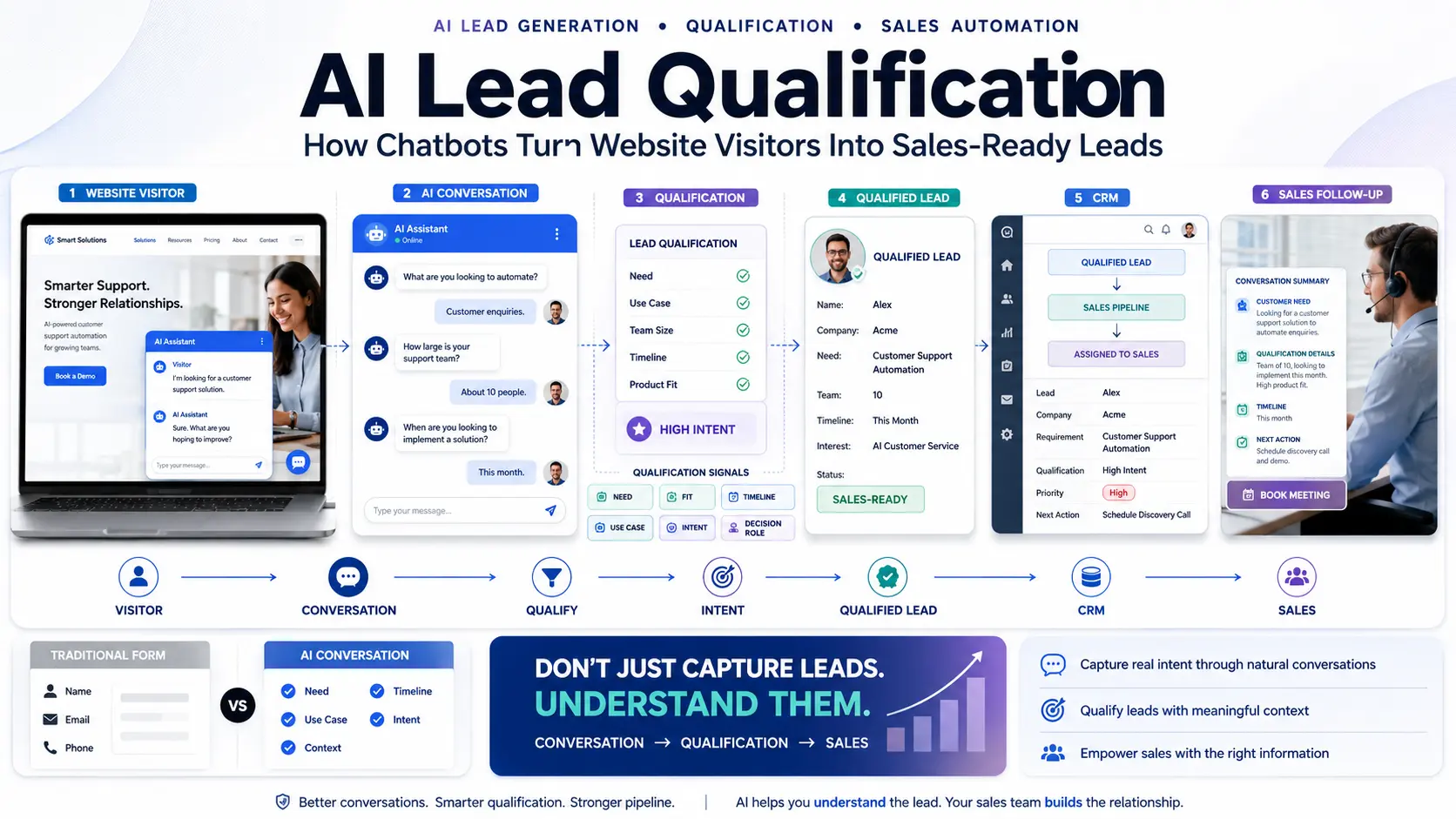
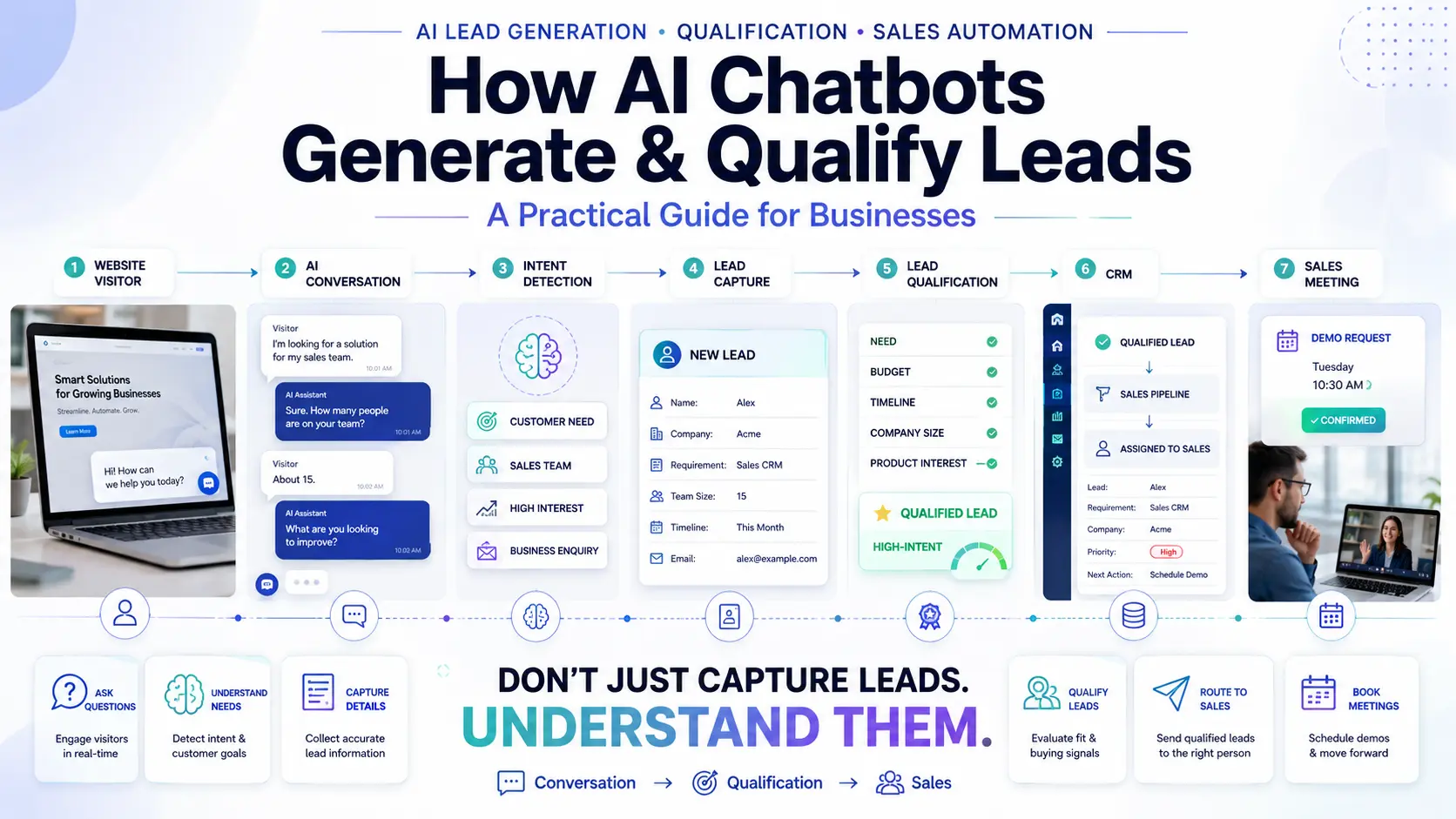
Yes. Financial institutions can use conversational AI for powerful lead generation. The workflow is seamless: Conversation → Intent → Qualification → Meeting → CRM.
The AI captures product enquiries, understands customer requirements, collects contact information, schedules meetings, and routes high-intent enquiries to the sales team. For a deep dive into this workflow, refer to our comprehensive articles on AI Lead Qualification and Website Chatbots for Lead Generation.
How Quillive Can Support Financial-Service Customer Conversations
Quillive is an AI Website Assistant designed to support customer-service and enquiry workflows securely and efficiently.
While Quillive does not independently handle regulated financial decisions, it acts as a highly effective conversational AI layer for your public-facing channels. Financial-service businesses use it to answer website questions using approved business information, capture and qualify enquiries, book branch appointments, and seamlessly hand complex conversations over to human teams. When integrated with a Pre-Sales CRM, it ensures that human agents possess all context before they engage the customer.
Frequently Asked Questions
What is an AI chatbot for financial services?
An intelligent assistant that answers inquiries, guides processes, and collects information for banks and institutions.
How do banks use AI chatbots?
To automate common FAQs, provide product details, schedule appointments, and route complex cases to live agents.
What can a banking chatbot do?
It explains account features, details eligibility criteria, provides branch hours, and guides users to correct departments.
What can financial-service chatbots automate?
General business information, policy overviews, preliminary application processes, and meeting bookings.
Are AI chatbots safe for financial services?
Yes, if deployed with strict data privacy, security, and compliance controls regarding authenticated actions.
Can AI chatbots replace bank employees?
No, they handle repetitive volume so humans can focus on complex problem-solving and authenticated transactions.
Can AI chatbots handle loan enquiries?
Yes, they can explain loan types and requirements, but they should not make final lending decisions.
Can AI chatbots help insurance customers?
Yes, by assisting with general policy info and explaining claims processes before escalating to an adjuster.
Can financial chatbots provide financial advice?
No. They should provide factual information and explicitly avoid personalized financial or investment advice.
When should a banking chatbot transfer a customer to a human?
During complex disputes, fraud reports, sensitive complaints, or requests for bespoke financial advice.
Can AI chatbots connect to banking systems?
Yes, enterprise deployments integrate with CRMs and scheduling tools via secure APIs.
Can financial-service chatbots qualify leads?
Yes, by asking preliminary questions to determine intent before routing to a sales officer.
Can financial chatbots book appointments?
Yes, they easily integrate with calendars to schedule meetings with branch managers or advisors.
What is the difference between a banking chatbot and conversational AI?
Conversational AI uses NLP to understand open questions, whereas traditional chatbots rely on rigid button menus.
Do chatbots improve customer satisfaction in finance?
Yes, by eliminating hold times for simple inquiries, they drastically improve the user experience.
Can AI chatbots detect fraud?
While backend AI detects fraud, customer-facing bots usually route fraud concerns directly to human investigators.
Are financial chatbots multilingual?
Yes, modern systems can instantly translate and converse in dozens of languages.
What happens if the AI gives wrong info?
RAG architecture prevents this by restricting the AI to only approved, uploaded business documents.
How long does implementation take?
Informational bots deploy quickly; deep authenticated integrations take longer due to compliance testing.
Is the conversation data stored securely?
Leading platforms comply with strict enterprise data privacy and security regulations to protect transcripts.
Conclusion
Financial institutions do not need to choose between AI efficiency and human empathy. The strongest operational approach is a unified hybrid system:
AI FOR REPETITIVE QUESTIONS + HUMANS FOR COMPLEX AND SENSITIVE CASES
By adopting a workflow where a Customer Question → AI Understanding → Helpful Response → Appropriate Action → Human Escalation When Needed → Customer Resolution, banks and financial firms can dramatically improve their service speed without compromising on quality or compliance.
For institutions ready to deploy a secure conversational layer, Quillive provides the necessary intelligence to automate information retrieval and support your human teams.

Quillnext Team
The Quillnext Team builds advanced conversational AI solutions that help businesses automate customer support, capture leads, and scale operations efficiently.
Visit Quillnext