The Static Form Problem
A website may receive thousands of visitors a month, but not every visitor is ready to talk to your sales team. Furthermore, not every visitor who wants to talk to your sales team is actually a good fit for your business.
Traditional B2B and service websites rely heavily on static lead forms. These forms typically ask for four basic pieces of information: Name, Email, Phone, and Company.
The problem? These basic fields do not tell a sales representative what the visitor actually needs, whether they are a good fit, how urgent their requirement is, what solution they are considering, or what their buying intent looks like. A sales rep must pick up the phone completely blind, resulting in wasted hours calling unqualified prospects.
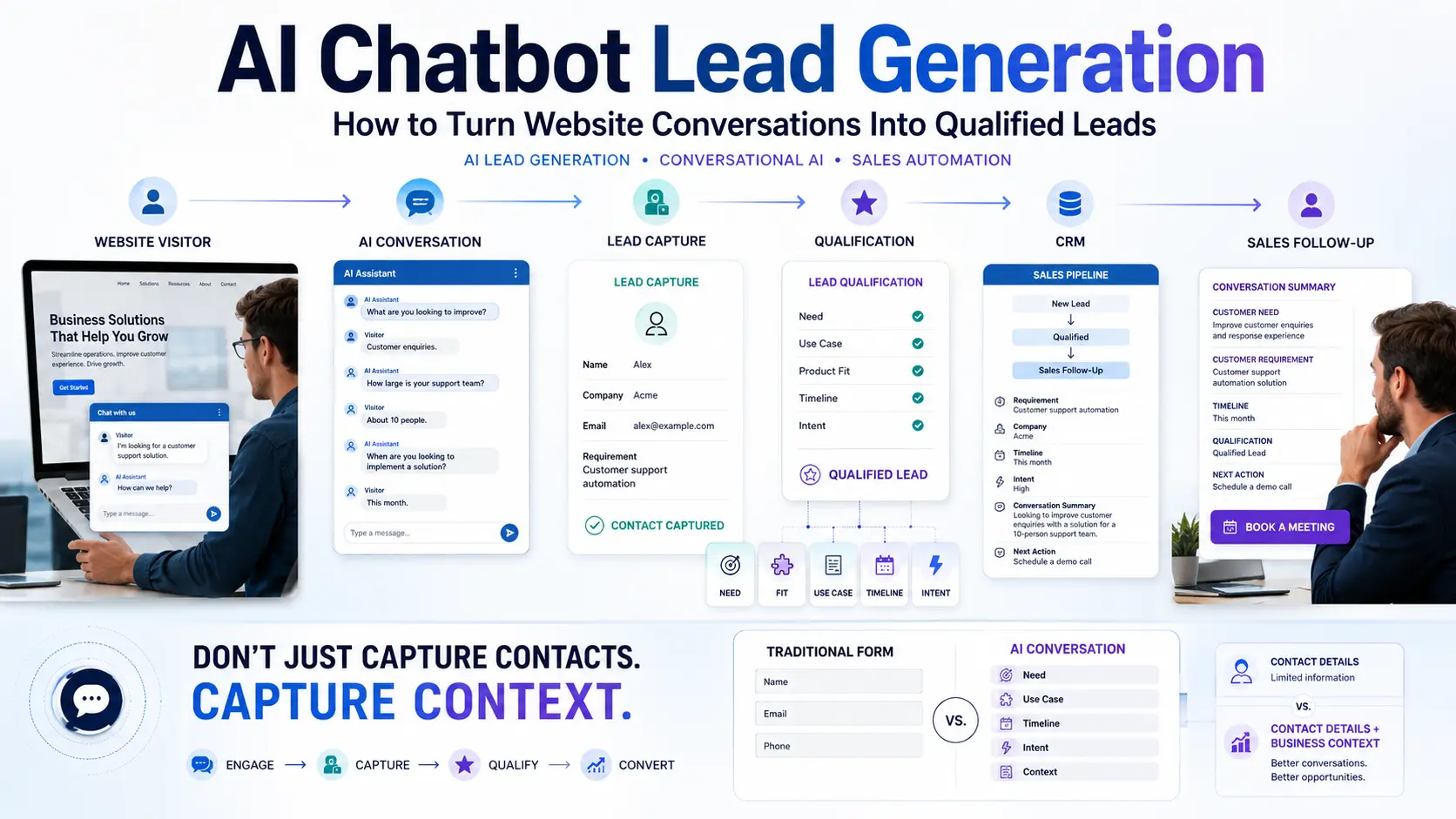
This is where an AI lead qualification chatbot steps in. By turning a static form into a dynamic conversation, businesses can evaluate prospects before the sales team ever gets involved. The fundamental difference to understand is this:
LEAD CAPTURE = COLLECTING CONTACT INFORMATION
LEAD QUALIFICATION = UNDERSTANDING WHETHER THE LEAD IS A GOOD SALES OPPORTUNITY
Quick Answer: How do AI chatbots qualify leads?
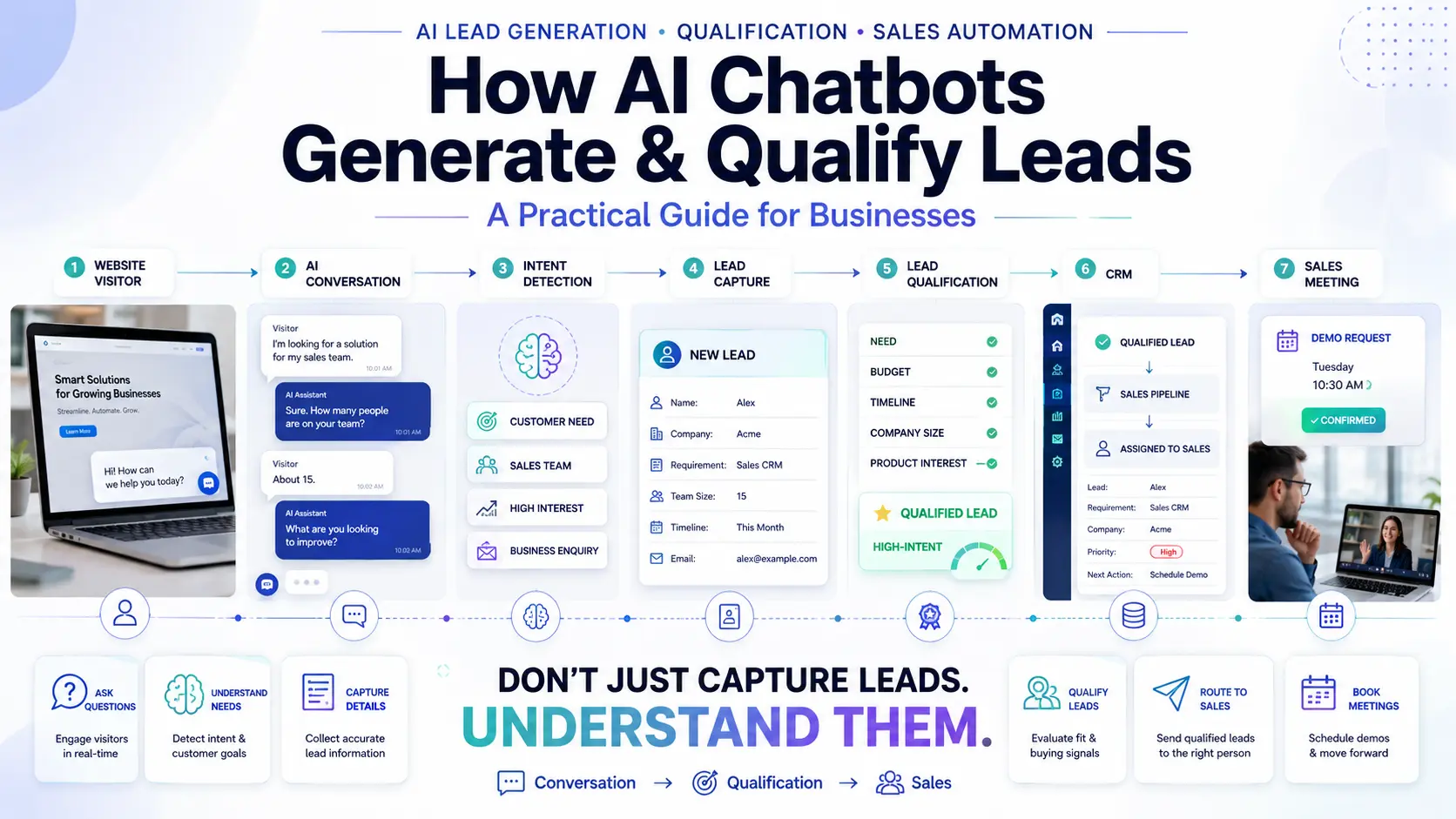
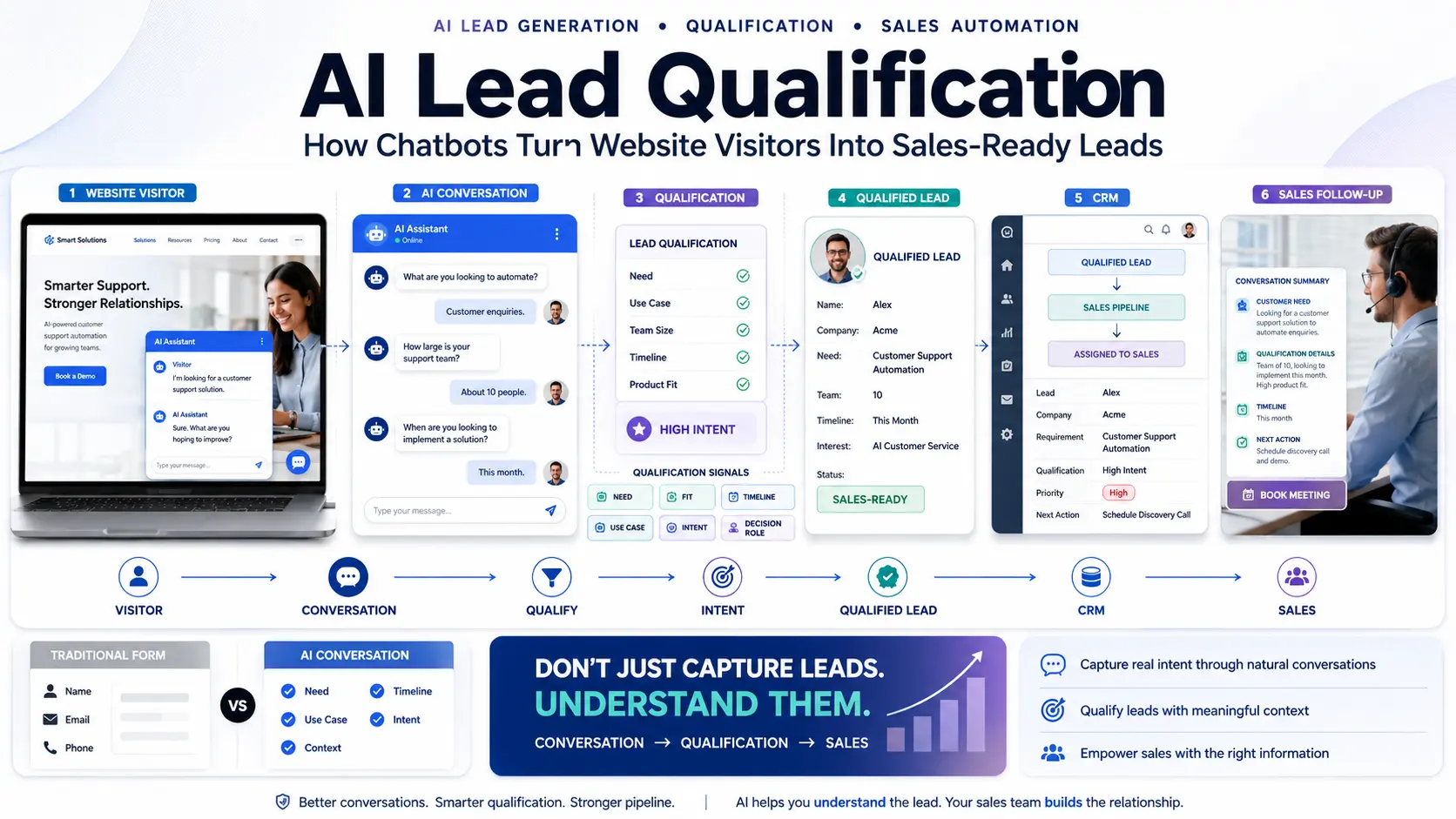
AI lead qualification uses conversational AI to ask relevant questions, understand visitor responses, identify buying intent, collect essential contact information, and determine whether a prospect meets predefined business criteria. The basic workflow moves from a website conversation to a qualified lead, which is then routed directly to a sales CRM.
VISITOR → AI CONVERSATION → INFORMATION → QUALIFICATION → CRM / SALES
What Is AI Lead Qualification?
AI lead qualification is the process of using artificial intelligence to evaluate a potential customer based on information gathered through an interactive conversation.
Rather than treating every visitor equally, an AI system analyzes the user's responses to determine their priority. Depending on the business model, the AI may evaluate:
- • The core business need
- • Timeline for purchase
- • Product or service fit
- • Buying intent signals
- • Company size or industry
- • Decision-making role
- • Budget (where appropriate)
- • Specific technical requirements
The exact criteria used for qualification depend entirely on what your business considers an "ideal customer."
Lead Capture vs Lead Qualification
It is a critical distinction that many marketers miss: a lead can be captured without being qualified. HubSpot heavily emphasizes the difference between marketing qualified and sales qualified leads.
| Lead Capture | Lead Qualification |
|---|---|
| Collects contact details | Evaluates potential fit |
| Name | Business need |
| Use case | |
| Phone | Timeline |
| Company | Budget where appropriate |
| Form submission | Buying intent |
| Creates a lead | Helps prioritize the lead |
An AI chatbot for lead generation must do both: it must capture the contact information and apply the qualification framework.
How Does an AI Chatbot Qualify Leads?
To understand how qualified leads with AI are generated, look at the complete, step-by-step process.
Step 1 — Start the Conversation
The chatbot proactively greets the visitor based on the page they are viewing.
AI: "Hi! What are you looking to accomplish today?"
Visitor: "We need a better way to manage inbound enquiries."
Step 2 — Understand the Requirement
The AI asks a follow-up question to dig deeper into the problem. These questions adapt dynamically to the visitor's responses.
AI: "What type of enquiries are you currently handling most often?"
Step 3 — Identify Fit
The chatbot cross-references the visitor's requirement with the business's trained knowledge base to determine if there is a product match.
Step 4 — Understand Timeline
Timeline is often a crucial qualification signal depending on the business model.
AI: "When are you looking to implement a solution?"
Possible responses: Immediately, This month, Next quarter, Just researching.
Step 5 — Understand Buying Intent
The chatbot distinguishes between a student doing general research, a competitor snooping, and a genuine buyer in active evaluation. (Note: AI cannot perfectly determine intent, but it can read strong conversational signals).
Step 6 — Collect Contact Information
Only ask for contact details when it makes sense in the flow of the conversation, avoiding unnecessary friction.
Step 7 — Route the Lead
Qualified leads are packaged and sent to the appropriate sales workflow.
QUALIFIED ↓ CRM ↓ SALES TEAM
What Questions Should an AI Lead Qualification Chatbot Ask?
A chatbot should not interrogate visitors. Questions must be relevant, short, highly contextual, and easy to answer. They must also be based directly on previous responses.
Common qualification categories include:
- Need: "What are you trying to solve?"
- Company / Business: "What type of business do you operate?"
- Team / Scale: "How many people are involved?"
- Use Case: "What would you like the solution to help you with specifically?"
- Timeline: "When are you looking to implement this?"
- Budget: "Do you have an allocated budget range?" (Discuss carefully; budget questions may be appropriate for agencies, but off-putting for SaaS products).
- Decision Role: "Are you evaluating this for yourself or on behalf of your team?"
- Next Step: "Would you like to speak with someone from our team?"
How AI Adapts Qualification Questions
Do not present a lead qualification chatbot as a system that simply follows one fixed, rigid questionnaire. The primary advantage of conversational qualification is its ability to branch dynamically.
Example of Branching Conversation
Visitor: "I'm looking for customer support automation."
AI: "What type of support requests do you receive most often?"
Visitor: "Mostly product questions."
AI: "How large is your support team?"
Visitor: "About 10 people."
AI: "Are you currently using a helpdesk or CRM?"
Notice how the next question always depends on the previous response. If the visitor had said "I am a solo founder," the AI would have skipped the question about the support team size. This contextual adaptation is what sets AI apart from static forms.
Lead Scoring vs Lead Qualification
It is helpful to understand the difference between scoring and qualifying.
- Lead Qualification: Determines whether a lead meets specific, binary criteria (e.g., Are they in the USA? Do they have a need?).
- Lead Scoring: Assigns a numerical or categorical priority based on defined conversational signals.
| Conversational Signal | Scoring Impact |
|---|---|
| Strong need articulated | High priority |
| Clear use case described | Positive signal |
| Immediate timeline (e.g., "ASAP") | Positive signal |
| Good product fit verified | Positive signal |
| "Just researching" | Lower priority |
| Outside target market / budget | Low priority / Disqualified |
There are no universal scoring formulas. Businesses must define their own scoring criteria based on historical sales data. As Salesforce notes regarding lead scoring, alignment between sales and marketing definitions is crucial.
What Makes a Lead "Qualified"?
There is no universal definition of a qualified lead. A qualified lead for one company may not be a qualified lead for another.
Generally, possible criteria include whether the visitor:
- Matches the target customer persona.
- Has a relevant need the product solves.
- Has a suitable use case.
- Has a reasonable timeline for implementation.
- Has purchasing authority or access to a decision-maker.
- Meets minimum service or geographic requirements.
- Shows meaningful buying intent (willing to meet).
Example AI Lead Qualification Conversation
Here is what a realistic, value-driven conversation looks like:
Visitor
"I'm interested in your customer support solution."
AI
"What type of support are you looking to automate?"
Visitor
"Website questions and product enquiries."
AI
"How many customer enquiries do you receive approximately?"
Visitor
"Several hundred each month."
AI
"Are you currently using a CRM or support platform?"
Visitor
"Yes, we use a CRM."
AI
"When are you hoping to improve your support process?"
Visitor
"This month."
AI
"Thanks. It sounds like your team may be a good fit. Would you like to speak with a specialist?"
In 60 seconds, the AI has collected: Need, Volume, Existing systems, Timeline, and Buying intent.
That context is vastly more useful to a sales representative than simply receiving an email saying: "John submitted a form."
When Should an AI Chatbot Stop Qualifying?
An AI chatbot should not ask endless questions. Qualification should stop the moment enough information has been collected to determine the next operational action.
The possible outcomes usually fall into these categories:
- Qualified: Send immediately to the sales workflow.
- Needs More Information: Continue the conversation or provide self-serve resources.
- Not a Fit: Politely explain limitations or redirect to a more appropriate service.
- Human Assistance Required: Transfer to a human support agent.
- Ready to Book: Offer a calendar widget for direct appointment scheduling.
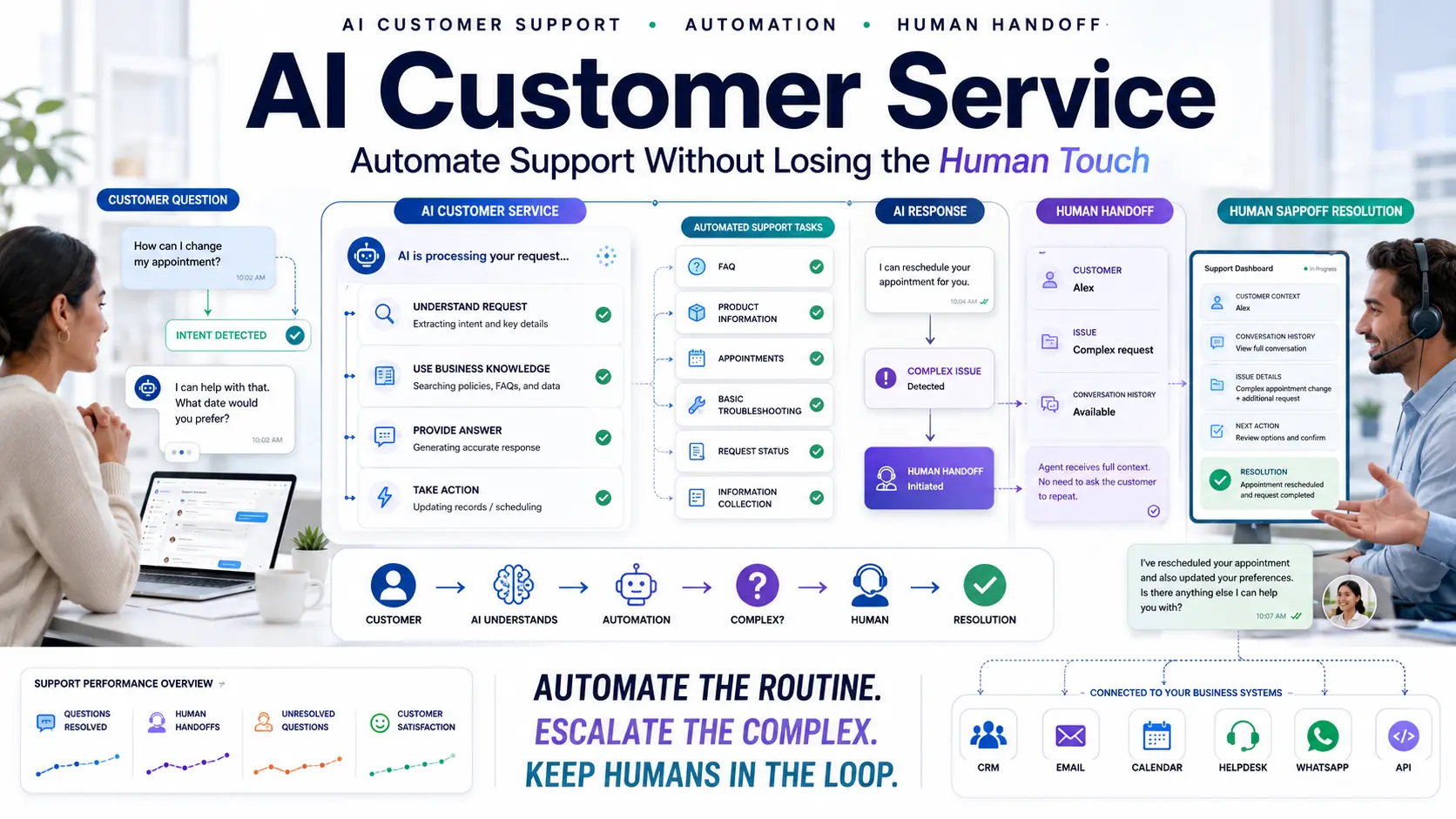
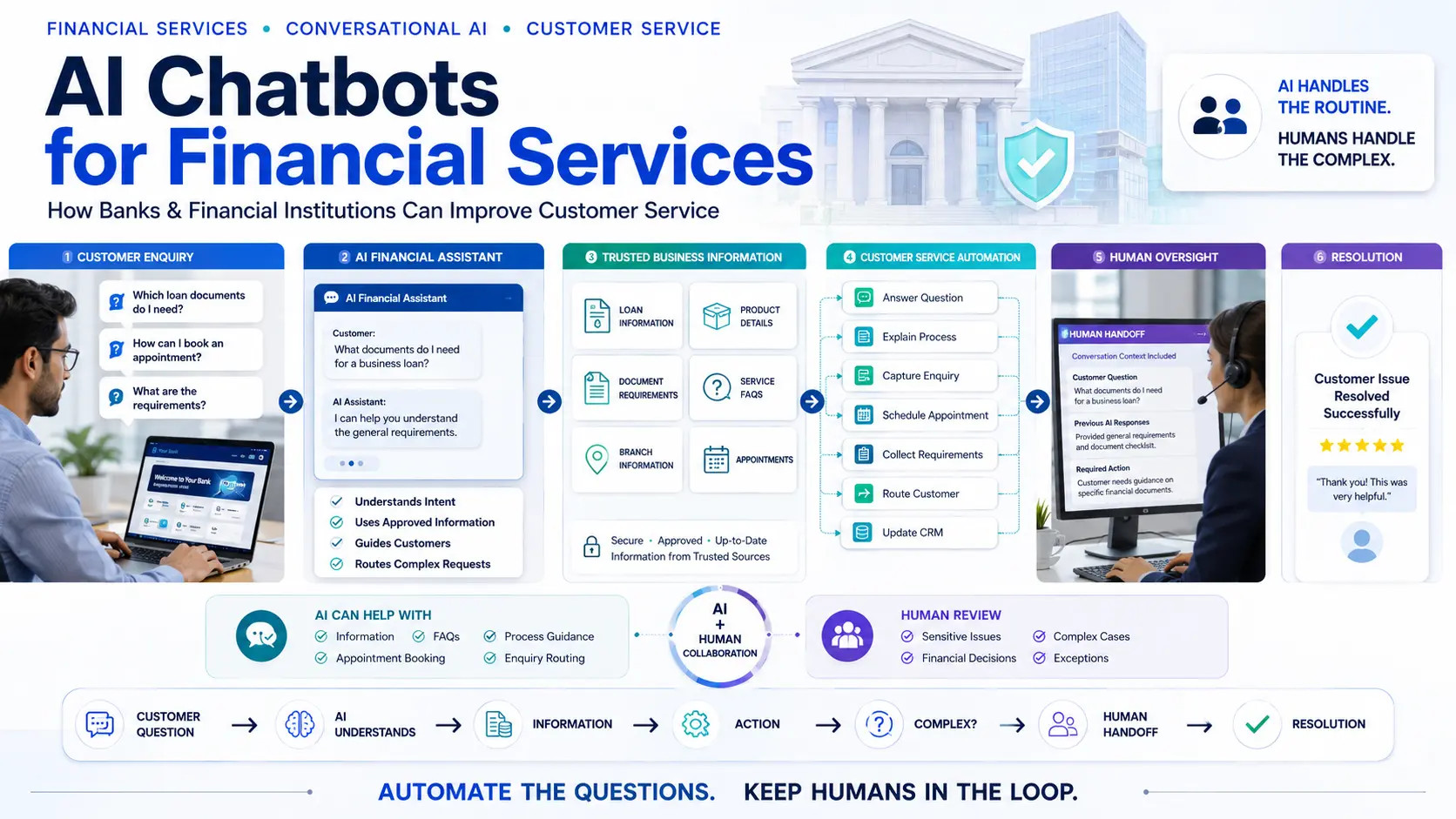
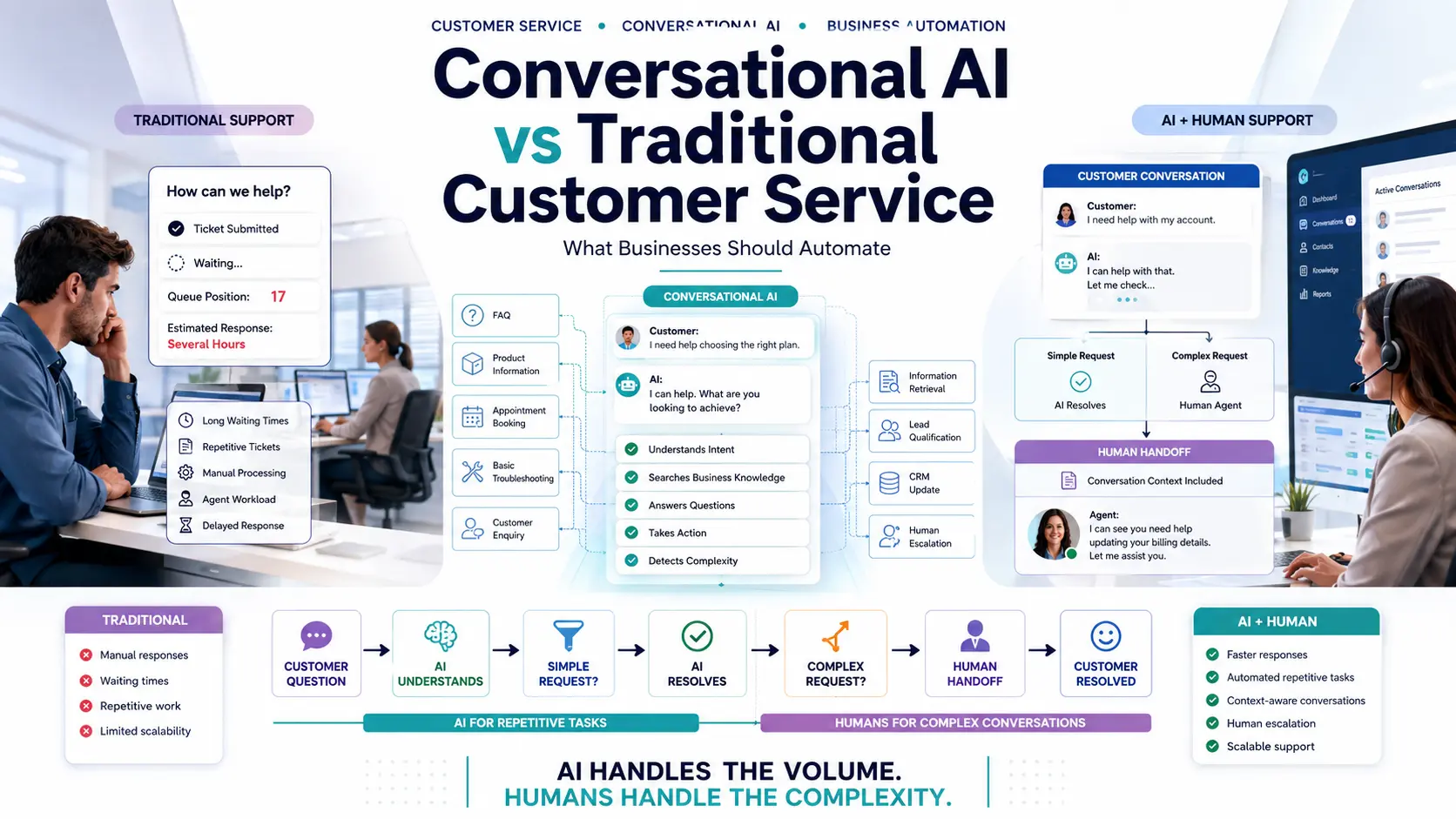
AI Lead Qualification and Human Handoff
Automation should act as a filter, not a wall.
AI → QUALIFICATION → HIGH-INTENT / COMPLEX → HUMAN SALES REP
When a lead is deemed high-intent, the human representative must receive the complete context. The customer should not have to repeat the entire conversation. The human should instantly see:
- Visitor contact details
- Stated requirements
- Qualification answers
- Full conversation history
- Intent level
- Suggested next step
For more on seamless transitions, see our guide on AI Customer Service and Human Handoff.
AI Lead Qualification and CRM Integration
A qualification engine is useless if the data is trapped inside the chatbot.
Without CRM integration:
CHATBOT ↓ LEAD ↓ MANUAL COPY / PASTE
This creates unnecessary administrative work and delays follow-up times.
With CRM integration:
CHATBOT ↓ QUALIFIED LEAD ↓ CRM ↓ SALES OWNER ↓ FOLLOW-UP
The data moves seamlessly.
When connecting these systems, businesses must utilize a dedicated Lead management CRM to ensure that the qualification context, not just the visitor's email address, is recorded for the sales team.
What Information Should Be Sent to the CRM?
Do not collect every field for every business. Only collect what is genuinely useful for the sales process.
| Information | Why It Matters |
|---|---|
| Name | Identification |
| Follow-up | |
| Phone | Direct contact where appropriate |
| Company | Account context |
| Requirement | Understand need |
| Use case | Product fit |
| Timeline | Sales priority |
| Qualification status | Lead prioritization |
| Conversation summary | Context |
| Next action | Sales workflow |
AI Lead Qualification for Different Business Models
Qualification strategies shift based on the industry:
- B2B Enterprise: Focus on company size, specific use cases, team size, decision-making role, and implementation timeline.
- SaaS: Focus on product need, existing software stacks, feature requirements, and demo intent.
- Professional Services: Focus on project requirements, scope, timeline, and rough budget constraints (where appropriate).
- High-Consideration Purchases (e.g., Real Estate): Focus on specific requirements, financial fit, timeline, and scheduling a consultation.
- E-commerce: Focus on product interest, purchase intent, and answering specific product questions.
AI Lead Qualification vs Traditional Lead Forms
Forms are not obsolete. They are still highly useful for straightforward requests (e.g., "Download this PDF"). But for sales generation, the comparison is stark:
| Traditional Form | AI Qualification |
|---|---|
| Fixed fields | Conversational questions |
| Same questions for everyone | Questions can adapt |
| Contact data only | Context + contact data |
| Limited intent information | More intent signals |
| Static experience | Interactive experience |
| Often short | Can progressively qualify |
Benefits of AI Lead Qualification
- Better Lead Context: Sales teams understand the exact enquiry before contacting the prospect.
- Faster Lead Routing: Qualified enquiries bypass support and enter the appropriate sales workflow immediately.
- Reduced Manual Qualification: Sales reps spend significantly less time asking basic discovery questions on the phone.
- More Conversational Experience: Visitors can explain their requirements naturally in their own words.
- Better Prioritization: Sales teams can focus strictly on leads matching defined criteria, ignoring the noise.
- Consistent Qualification: The business applies the exact same, unbiased qualification framework across every conversation.
Limitations and Risks
No system is perfect. Businesses must be aware of the risks involved in conversational qualification:
- Incorrect AI interpretation of complex user needs.
- Poor qualification criteria defined by the business.
- Over-questioning, which leads to chat abandonment.
- False positives (sending bad leads to sales).
- False negatives (rejecting good leads prematurely).
- Outdated business information causing incorrect answers.
- Bad CRM integrations that drop lead data.
- Poor human handoff protocols trapping users with a bot.
- Over-automation without human oversight.
AI qualification should be monitored and improved continuously. As Gartner recommends regarding AI in sales, human oversight remains essential.
How to Build a Good AI Lead Qualification Process
Follow this 8-step practical framework:
IDEAL CUSTOMER DEFINED
↓
QUALIFICATION CRITERIA SET
↓
ESSENTIAL QUESTIONS IDENTIFIED
↓
BRANCHING CONVERSATION DESIGNED
↓
LEAD CAPTURE CONNECTED
↓
CRM INTEGRATED
↓
HUMAN HANDOFF RULES DEFINED
↓
MEASURE AND IMPROVE
How to Measure AI Lead Qualification
Do not only measure the raw number of leads generated. "More leads" does not necessarily mean better results. Track the following:
- Conversations started
- Leads captured
- Qualification sequence completion rate
- Total qualified leads
- Total unqualified leads
- Human handoff rate
- Meetings booked natively
- Sales acceptance rate (did sales agree the lead was qualified?)
- Ultimate sales conversion
The most important metric is the QUALITY of the leads entering the sales pipeline.
Common AI Lead Qualification Mistakes
- Asking too many questions: Keep it under 5 key questions.
- Asking irrelevant questions: Don't ask for company size if you sell B2C software.
- Collecting information sales doesn't use: If sales ignores the timeline data, don't ask for it.
- Using generic qualification criteria: Define exactly what makes a lead good for your specific company.
- Sending every visitor to sales: This defeats the entire purpose of an AI filter.
- Rejecting leads too early: Leave room for ambiguous queries to reach a human.
- Not connecting the CRM: Never force sales to copy-paste.
- Not giving sales conversation context: Provide the transcript, not just the email.
- No human handoff: Always provide an escape hatch to a live rep.
- Never reviewing conversations: Read the transcripts weekly to improve the AI's logic.
How Quillive Can Support AI Lead Qualification
Quillive is designed as an intelligent AI Website Assistant that helps businesses manage this exact workflow.
Businesses can use Quillive to engage website visitors proactively, answer their questions using trained business knowledge, understand visitor requirements, capture leads, qualify enquiries dynamically, and book appointments. By seamlessly passing conversations to human team members and supporting broader sales workflows, it is one solution businesses should evaluate for conversational lead capture and qualification.
AI Lead Qualification Checklist
Strategy & Conversation
- Define ideal customer
- Define qualification criteria
- Define sales handoff rules
- Start with an open question
- Use branching logic
- Avoid unnecessary questions
Capture & Qualification Criteria
- Name & Email
- Business information
- Requirement / Need
- Product Fit
- Buying Intent
- Timeline
Sales Integration & Measurement
- CRM integration active
- Lead routing configured
- Conversation summary sent to sales
- Appointment booking active
- Track Qualified leads
- Track Meetings booked
- Track Sales acceptance
- Track Unresolved conversations
Frequently Asked Questions
What is AI lead qualification?
The process of using artificial intelligence to evaluate a potential customer based on information gathered through an interactive chat.
What is an AI lead qualification chatbot?
A conversational tool that asks visitors relevant questions to determine their fit, budget, timeline, and buying intent.
How do chatbots qualify leads?
They ask progressive, contextual questions, adapting follow-ups based on the user's previous answers.
Can AI chatbots qualify leads?
Yes. They act as automated SDRs to filter out unqualified traffic and prioritize high-intent prospects.
What questions should a lead qualification chatbot ask?
It should ask about the core problem, company size, timeline, specific use case, and sometimes budget.
What is the difference between lead capture and lead qualification?
Lead capture collects contact info. Lead qualification evaluates whether that person is actually a good fit for your business.
Can AI chatbots identify buying intent?
Yes, by analyzing urgency, question specificity, and willingness to book a meeting.
Can AI chatbots score leads?
Yes, they can assign priority levels (High, Medium, Low) based on how answers match your ideal customer profile.
What makes a lead qualified?
They match your target persona, have a relevant need, and demonstrate a reasonable timeline or buying intent.
Can AI lead qualification integrate with CRM?
Yes, CRM integration is critical so sales teams receive the full conversation history.
Can AI chatbots book sales meetings?
Yes, qualified leads can be offered a calendar link to book directly with a sales rep.
Can AI chatbots send qualified leads to sales?
Yes, automated routing can send leads instantly via email, Slack, or directly into the CRM pipeline.
How accurate is AI lead qualification?
High, provided businesses define clear, objective criteria, though ambiguous conversations still require human judgment.
Is AI lead qualification suitable for small businesses?
Yes, it saves limited staff time by filtering out low-quality enquiries automatically.
Can AI qualify B2B leads?
Yes, B2B qualification is a primary use case, focusing on company size, industry, and requirements.
Can AI qualify SaaS leads?
Yes, it can ask prospects about their current tech stack and feature requirements before offering a demo.
What are the risks of AI lead qualification?
Asking too many questions, rejecting good leads prematurely, or failing to integrate with a CRM.
How should businesses measure qualified leads?
Measure the sales acceptance rate of leads and the ultimate conversion rate into paying customers.
Can AI replace sales qualification?
It replaces the initial discovery phase, but human reps must still perform deeper qualification during the sales call.
How do you build an AI lead qualification chatbot?
Define your ideal customer, identify 3-5 critical questions, design branching logic, and connect it to your CRM.
Conclusion
The goal of AI lead qualification is not to collect the most leads possible. It is to help businesses identify WHICH LEADS DESERVE ATTENTION.
By replacing static forms with conversational AI, businesses can capture context, identify intent, and prioritize their sales pipeline efficiently. The ideal workflow remains consistent:
VISITOR → CONVERSATION → UNDERSTANDING → QUALIFICATION → CRM → SALES
The best systems combine AI automation to handle the initial discovery with human sales judgment to close the deal.
To explore how conversational qualification can integrate into your website, review how the Quillive AI Website Assistant manages this workflow for growing businesses.

Quillnext Team
The Quillnext Team builds advanced conversational AI solutions that help businesses automate customer support, capture leads, and scale operations efficiently.
Visit Quillnext