The Problem with Traditional Lead Forms
A familiar scenario for modern businesses: you spend heavily on marketing to drive thousands of visitors to your website, but only a tiny fraction actually convert into leads.
For decades, businesses have relied on traditional "Contact Us" forms. These forms demand that a visitor stop what they are doing, enter their name, email, phone number, and a message, and then submit the form into a void—hoping someone eventually replies. This creates immense friction. According to research from HubSpot, high-friction forms are one of the primary reasons visitors abandon landing pages.
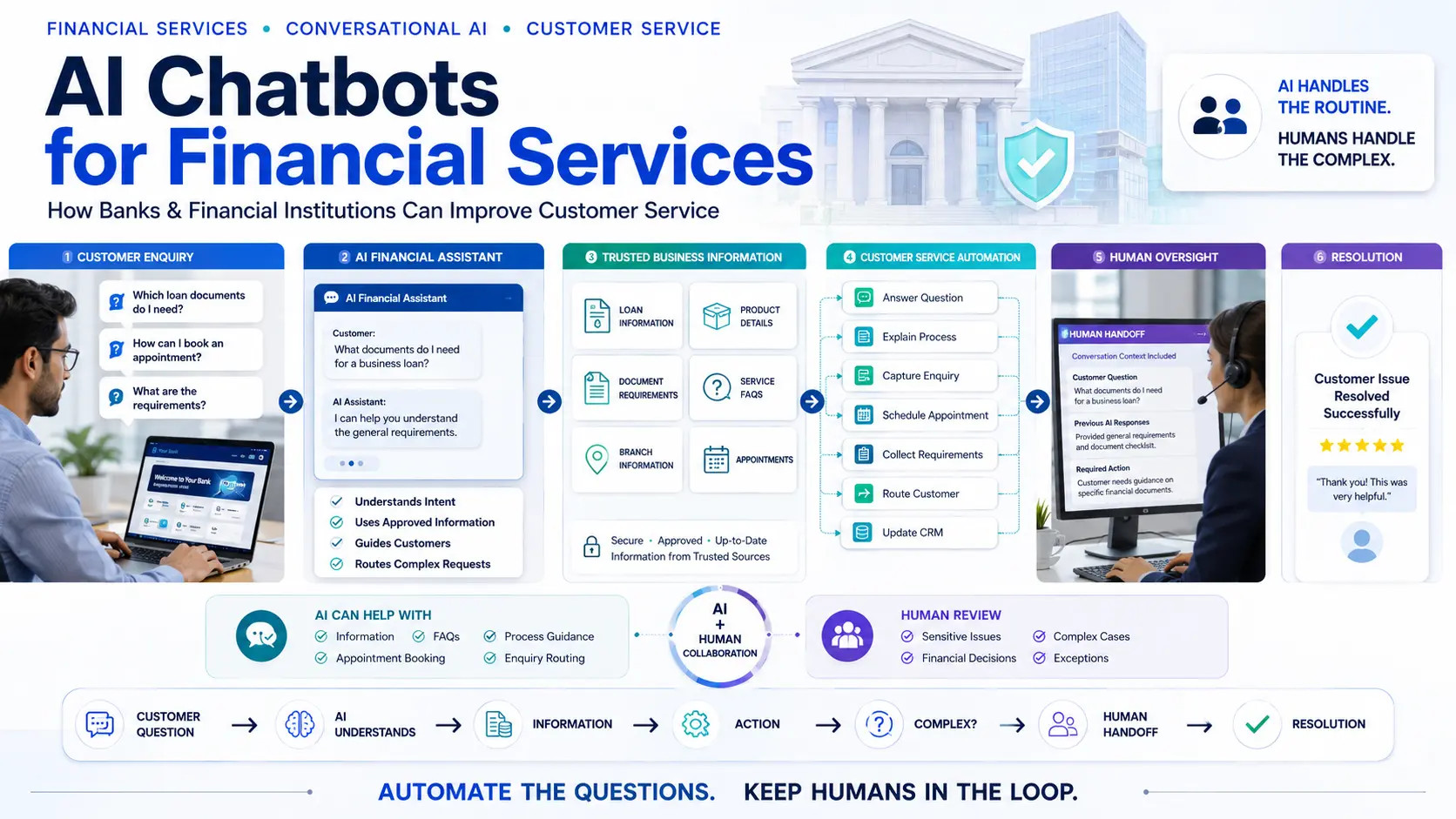
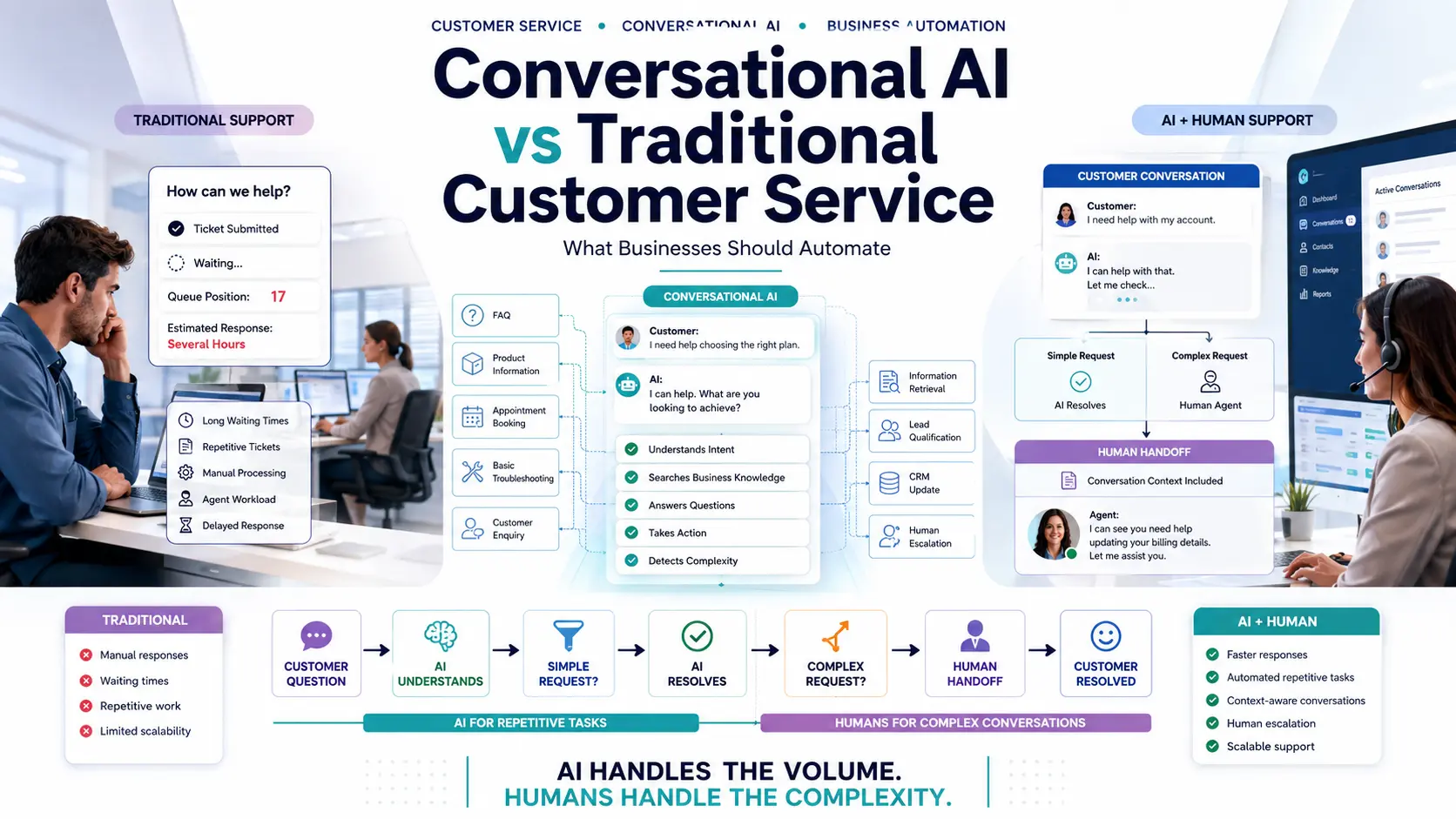
Conversational AI fundamentally changes this dynamic. Instead of presenting a static wall of fields, an AI chatbot for lead generation allows the visitor to interact naturally. The chatbot can proactively start a conversation, understand exactly what the visitor needs, answer preliminary questions, and seamlessly capture their contact information and qualification criteria within the chat flow itself.
Quick Answer: How do chatbots generate leads?
AI chatbots generate leads by proactively engaging website visitors in real-time conversations. They understand the visitor's intent, capture necessary contact information, and ask strategic qualification questions. Once the AI determines that a lead is a good fit, it can route that high-intent prospect directly to the sales team, sync the data to a CRM, or even book a meeting on the calendar. A strong AI chatbot doesn't just collect emails; it understands what the visitor wants, whether they are a fit, and what should happen next.
What Is an AI Lead Generation Chatbot?
An AI lead generation chatbot is a conversational tool designed specifically to move a user through a sales pipeline rather than simply answering support tickets.
The difference between a traditional form and conversational lead capture is profound:
- Traditional: Form → Submit → Wait → Sales Outreach
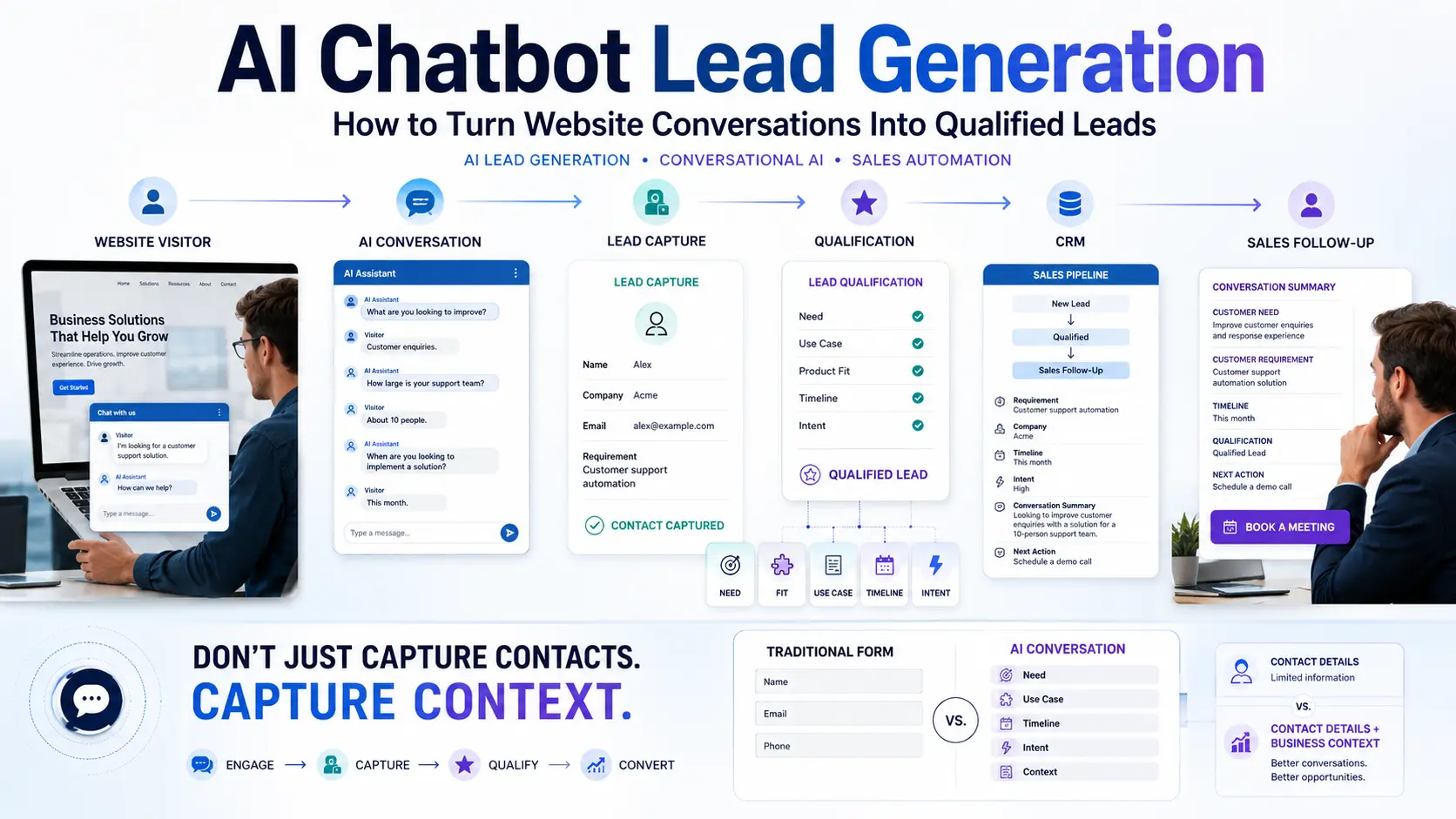
- Conversational: Chatbot Question → Conversation → Intent Detected → Qualification Criteria Gathered → Contact Captured → Sales Handoff / Meeting Booked
As Gartner notes, B2B buyers increasingly prefer self-guided digital experiences. Chatbots provide that autonomy while still securing the lead.
The Complete Pipeline: How AI Chatbots Generate Leads
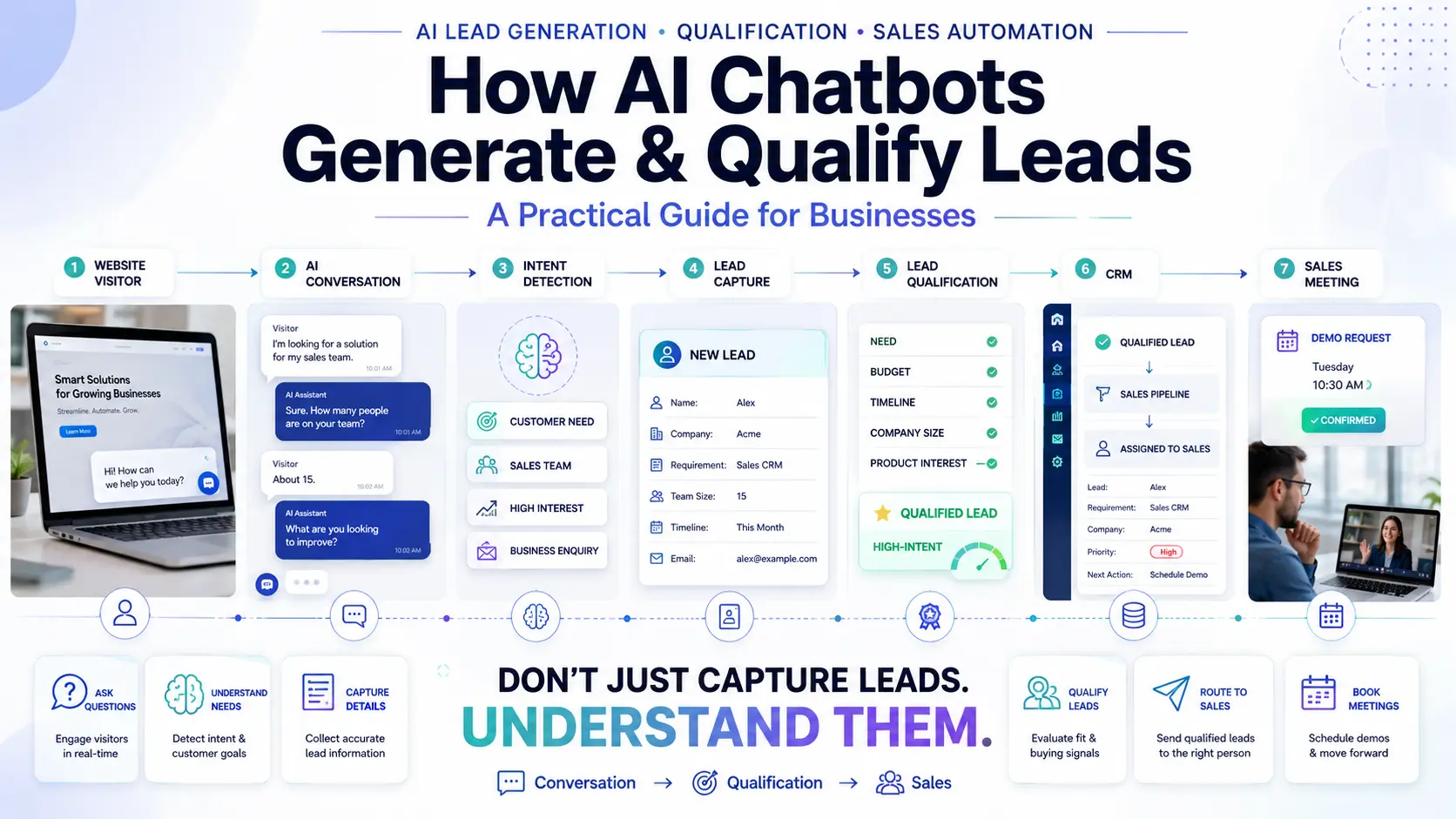
Generating a lead is a multi-step process. The AI acts as a digital Sales Development Representative (SDR) by following this exact pipeline:
Step 1 — Engage the Visitor
The chatbot proactively invites the visitor into a conversation using a contextual hook based on the page they are viewing. Example: "Looking for a software solution for your team? I can help you find the right plan."
Step 2 — Understand Intent
The AI analyzes the user's initial response to identify what they want. Is it a product enquiry, pricing request, support issue, or a request for a consultation?
Step 3 — Ask Relevant Questions
Instead of forcing every visitor down the same rigid path, the AI asks dynamic, conversational questions based strictly on the identified intent.
Step 4 — Capture Contact Information
Once trust is established, the AI collects appropriate details such as Name, Email, Phone, Company, and specific requirements.
Step 5 — Qualify
The AI determines if the prospect matches your buyer persona by evaluating their budget, timeline, company size, and product interest.
Step 6 — Route
Qualified leads are sent to the sales team, while support queries or unqualified leads are routed elsewhere.
Step 7 — Take the Next Action
The AI finalizes the interaction by booking a meeting, requesting a demo, sending a brochure, and syncing the data to the CRM.
AI Lead Generation Chatbot vs Traditional Lead Forms
Do chatbots always beat forms? Not necessarily (for instance, long complex applications often still require forms). However, for top-of-funnel capture, the comparison is stark:
| Feature | Traditional Lead Form | AI Chatbot |
|---|---|---|
| Visitor Engagement | Low (Passive) | Conversational (Proactive) |
| Questions | Fixed / Rigid | Dynamic / Contextual |
| Intent Understanding | Limited | Stronger (NLP analysis) |
| Qualification | Manual (SDR review needed) | Automated (Instant scoring) |
| Contact Capture | Yes | Yes |
| Personalization | Limited | Dynamic |
| Meeting Booking | Requires a separate page/process | Integrated natively in chat |
| Human Handoff | Only after submission | Live, during the conversation |
For a deeper dive into tools that manage this, see our comparison of the best lead generation tools.
How Chatbots Qualify Leads
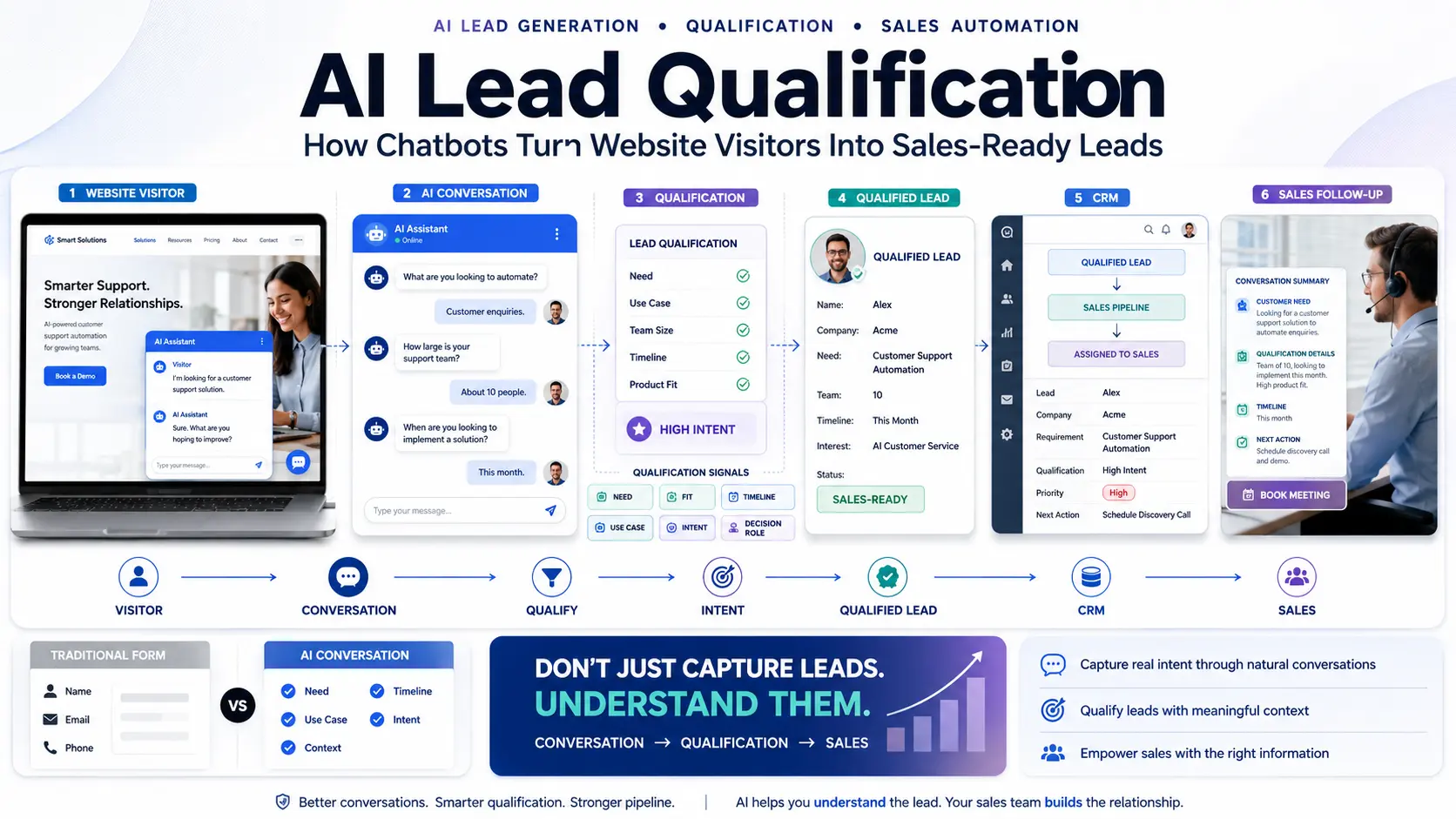
Capturing a lead is only half the battle; ensuring the lead is worth your sales team's time is the real ROI. An AI lead qualification chatbot evaluates prospects across several categories:
- Need: "What specific features are you looking for?" (Ensures product fit).
- Budget: "What budget range has your team allocated for this project?" (Filters out window shoppers).
- Timeline: "When are you planning to implement this solution?" (Determines urgency).
- Company / Project: "How large is your sales team?" (Determines account size/tier).
- Location: "Which market are you primarily operating in?" (Useful for routing to regional reps).
- Intent: "Would you like to schedule a 15-minute demo to see it in action?" (Checks readiness to buy).
Crucially, the questions must depend on the business. A B2B SaaS company cares about team size, while a real estate agent cares about location and budget.
Example: An AI Lead Qualification Conversation
Here is how a conversational qualification flow replaces a static form naturally:
Visitor: "I'm looking for new CRM software."
AI: "I can help with that. Are you mainly looking for a sales CRM, customer support ticketing, or both?"
Visitor: "Just a sales CRM."
AI: "Got it. To make sure I recommend the right tier, roughly how many people are on your sales team?"
Visitor: "About 15."
AI: "Perfect. Are you currently using another CRM system, or starting from scratch?"
Visitor: "Yes, we use an older system but we're considering switching soon."
AI: "Thanks! Based on your team of 15, our Pro Plan would be a great fit to replace your old system. Would you like to schedule a quick demo with our team to see how it compares?"
Notice that the AI did not present a five-field form. It gathered the prospect's Need, Team Size, and Timeline conversationally, building rapport before asking for the conversion. For more on this, read our specific guide on AI Lead Qualification.
How AI Determines Lead Intent
While AI cannot perfectly predict the future, it is excellent at identifying buying signals to gauge intent:
- Low Intent: "I am just researching options." (AI responds by offering an eBook or subscribing them to a newsletter).
- Medium Intent: "I want to compare your pricing with competitor X." (AI provides feature comparisons and offers to answer specific questions).
- High Intent: "I want a demo." (AI immediately asks for an email and pushes to a calendar).
- Very High Intent: "We need to implement this next month." (AI flags this as urgent, notifies the sales team immediately, and prioritizes the CRM record).
Intent directly influences the chatbot's routing behavior and determines how aggressively the sales team should follow up.
What Information Should an AI Lead Generation Chatbot Collect?
Do not interrogate your visitors. Collect only what is genuinely useful to move the deal forward.
| Information | Why It Matters |
|---|---|
| Name | Essential for personalization and CRM creation. |
| Required for asynchronous sales follow-up and marketing. | |
| Phone Number | Critical for direct SDR outreach (if applicable to your industry). |
| Company Name | Allows sales to research the account before the call. |
| Requirement | Understands the core problem they are trying to solve. |
| Budget | Filters out leads who cannot afford your service. |
| Timeline | Dictates follow-up urgency (buying signals). |
| Location | Ensures routing to the correct geographic sales territory. |
| Product Interest | Provides context so the rep knows what to pitch. |
How AI Chatbots Route Qualified Leads
Not all leads belong to the same person. A sophisticated conversational flow looks like this:
Visitor → AI Qualification
↓
Lead Meets High-Value Criteria?
↓
Route to Enterprise Sales
Send to Nurture Sequence
Proper routing ensures that the Customer Success team handles support, Admissions handles students, and Account Executives handle high-ticket enterprise sales.
Connecting AI Lead Generation to a CRM
Lead generation does not stop when the chat window closes. If the chatbot data isn't logged, the lead is lost.
The required workflow is: CHATBOT → QUALIFIED LEAD → CRM → SALES OWNER → FOLLOW-UP → MEETING.
Integrating your chatbot with a dedicated Pre-Sales CRM is non-negotiable. The CRM should automatically capture the lead's contact details, the qualification score, and the entire conversation transcript so the sales rep has complete context before picking up the phone.
Can AI Chatbots Book Meetings Automatically?
Yes, integrating meeting booking is the holy grail of chatbot lead generation.
When a chatbot identifies high intent and completes qualification, it can offer available meeting times (by connecting to tools like Calendly or native scheduling software). The visitor selects a time, the AI confirms the appointment, and passes the entire conversation context to the sales team.
QUALIFY → BOOK → CRM → SALES FOLLOW-UP
Note: This requires proper calendar integrations; the AI cannot magically book meetings if it doesn't know your sales team's availability.
AI Lead Generation Across Different Industries
- Real Estate: Captures budget, preferred location, buying timeline, and books property viewings.
- Education: Collects course interest, prior qualifications, and books admissions appointments.
- SaaS: Captures company size, use case, and routes high-intent users to book demos.
- Healthcare: Captures service enquiries and routes patient appointment requests appropriately.
- Travel: Captures destination, dates, group size, and booking intent.
Common AI Lead Generation Chatbot Mistakes
- Asking too many questions: Keep qualification to 3-4 vital questions.
- Asking for contact details too early: Provide some value or answer a question before asking for an email.
- Using generic questions: Tailor your flow to your specific industry.
- No clear next step: Always guide the user to a demo, meeting, or human handoff.
- No CRM integration: Leads die if they aren't synced instantly to a sales rep.
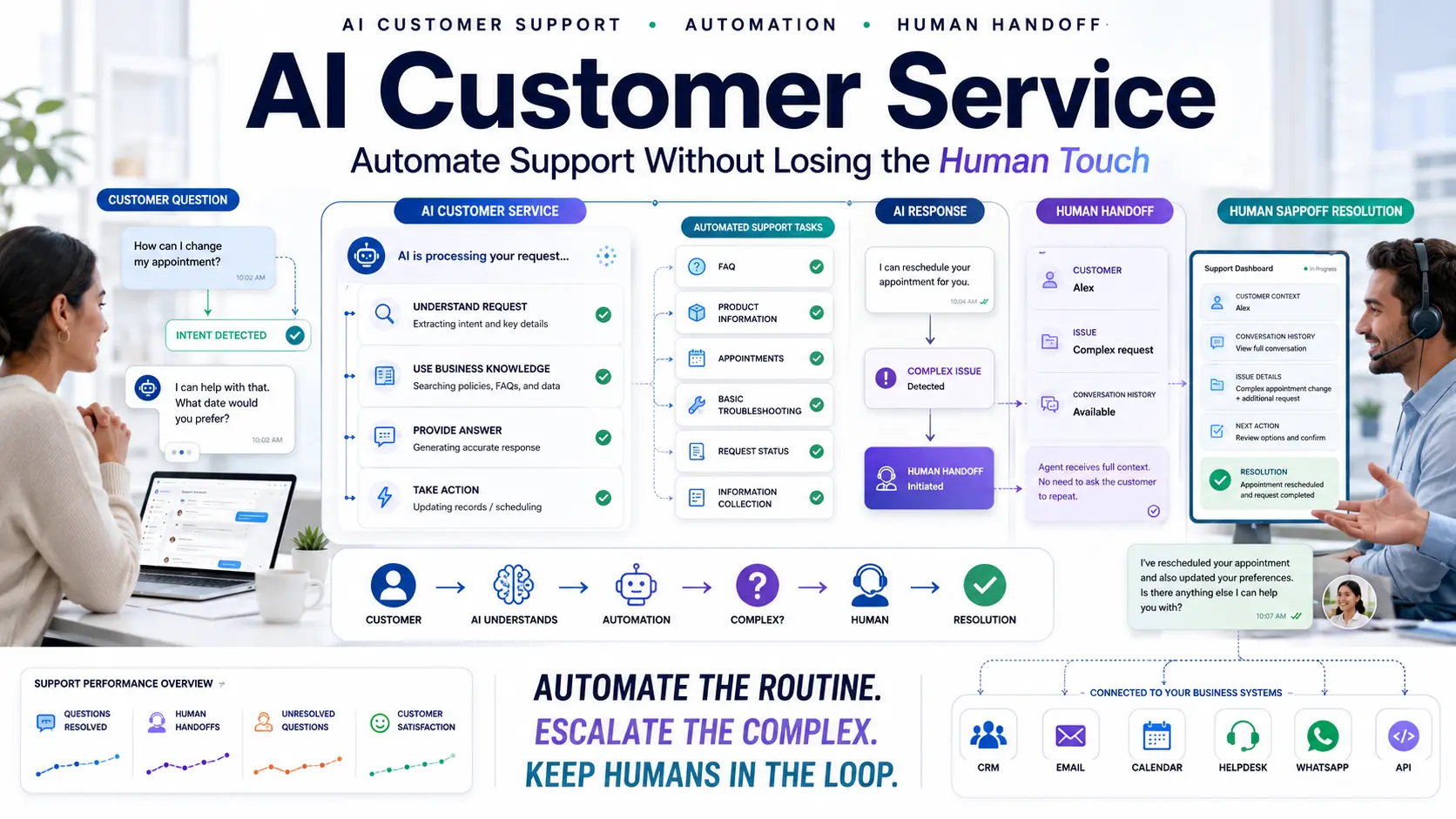
- No human handoff: Don't trap high-intent buyers in an endless AI loop.
- Poor qualification criteria: Sending every single chat to sales wastes their time.
- Collecting unnecessary personal information: Respect privacy; don't ask for a home address if you sell software.
- Treating every visitor as a sales lead: Separate support traffic from sales traffic early.
- Not measuring lead quality: 100 bad leads are worse than 10 great ones.
How to Build an AI Lead Generation Strategy
Implement your chatbot systematically:
- Step 1: Define your ideal customer persona.
- Step 2: Identify high-value website pages (Pricing, Contact, Product pages).
- Step 3: Identify common questions visitors ask before buying.
- Step 4: Create strict qualification criteria (BANT: Budget, Authority, Need, Timeline).
- Step 5: Design the conversational logic flows.
- Step 6: Define lead-routing rules (Who gets the lead?).
- Step 7: Connect your Lead Management CRM.
- Step 8: Connect meeting scheduling software.
- Step 9: Create seamless human handoff protocols.
- Step 10: Measure results and optimize.
How to Measure AI Chatbot Lead Generation
Success is not merely "number of chats." The real objective is generating QUALIFIED BUSINESS OPPORTUNITIES. Measure:
- Lead capture rate (Chats that result in emails)
- Qualification rate (Leads that pass your criteria)
- Meeting bookings (Demos scheduled)
- Lead-to-meeting rate
- Sales conversion rate
- Cost per qualified lead
How Quillive Helps Businesses Generate and Qualify Leads
Quillive serves as an intelligent AI Website Assistant designed to reduce friction and help sales teams receive better-qualified enquiries.
By engaging website visitors conversationally, Quillive can answer preliminary questions, understand visitor requirements, and capture contact information dynamically. It is built to qualify enquiries based on your rules, book appointments directly, and seamlessly connect the lead workflow with your business systems. By handing complex or high-intent conversations over to human teams, Quillive ensures that your sales reps spend their time closing deals rather than answering repetitive questions.
Frequently Asked Questions
What is an AI lead generation chatbot?
An intelligent assistant that proactively engages visitors, identifies their needs, collects contact info, and routes them to sales.
How does a chatbot generate leads?
By starting natural conversations and requesting contact details in exchange for assistance, rather than waiting for forms to be filled.
How do chatbots qualify leads?
They ask dynamic questions regarding a prospect's budget, timeline, and product interest to score their buying intent.
Can AI chatbots capture contact information?
Yes, they are highly effective at capturing names, emails, and phone numbers natively within the chat.
Can chatbots qualify sales leads?
Yes, by matching the user's answers against your ideal customer profile before notifying sales.
What questions should a lead qualification chatbot ask?
Questions should revolve around the visitor's core problem, timeline, company size, and budget.
Can AI chatbots book meetings?
Yes, by integrating with calendar tools, qualified leads can book appointments instantly.
Can AI chatbots connect to CRM?
Absolutely. They can sync transcripts and lead data directly to platforms like QuillCRM.
What is the difference between a chatbot and a lead generation chatbot?
Standard chatbots answer FAQs; lead-gen chatbots are designed to capture contact data and push prospects down the funnel.
Are AI chatbots better than lead forms?
For top-of-funnel engagement, yes. They reduce friction by replacing static fields with an interactive conversation.
Can AI chatbots generate qualified leads?
Yes, they act as an automated SDR layer, filtering out unqualified traffic before it hits your sales team.
How does conversational AI improve lead generation?
It provides instant gratification to users while engaging them when their intent is at its highest.
What is an AI lead qualification chatbot?
A bot that scores leads in real-time based on their conversational inputs regarding budget and need.
Can website chatbots capture leads?
Yes, placing them on high-intent pages (like Pricing or Features) is a proven lead capture strategy.
How can businesses measure chatbot lead generation?
By tracking lead capture rates, meeting booking rates, and the ultimate sales conversion rate of those leads.
Conclusion
A high-performing AI chatbot for lead generation should never simply ask, "What's your email?"
Instead, it should utilize conversational intelligence to understand WHAT THE VISITOR NEEDS, determine WHETHER THEY ARE A GOOD FIT, and decide WHAT THEY SHOULD DO NEXT.
By implementing the workflow of VISITOR → CONVERSATION → QUALIFICATION → CRM → SALES, businesses can drastically increase their website conversion rates while ensuring their sales teams only spend time on high-quality opportunities.
To see how this can work for your business, explore how Quillive can automate your conversational pipeline today.

Quillnext Team
The Quillnext Team builds advanced conversational AI solutions that help businesses automate customer support, capture leads, and scale operations efficiently.
Visit Quillnext