The Missing Link in Website Lead Generation
Many businesses spend massive budgets driving traffic to their websites, only to lose potential customers at the final hurdle. Visitors leave without converting because they do not want to submit a static form, they have unanswered questions, they are not ready for a high-pressure sales call, or they simply do not know what their next step should be.
Traditional lead generation depends heavily on a highly frictionless, rigid path:
VISITOR ↓ FORM ↓ SALES TEAM
The limitation is obvious. A form can collect a name and email, but it usually does not capture much context about why the visitor is interested, how urgent their need is, or whether they actually fit your ideal customer profile.
Conversational AI introduces a powerful alternative:
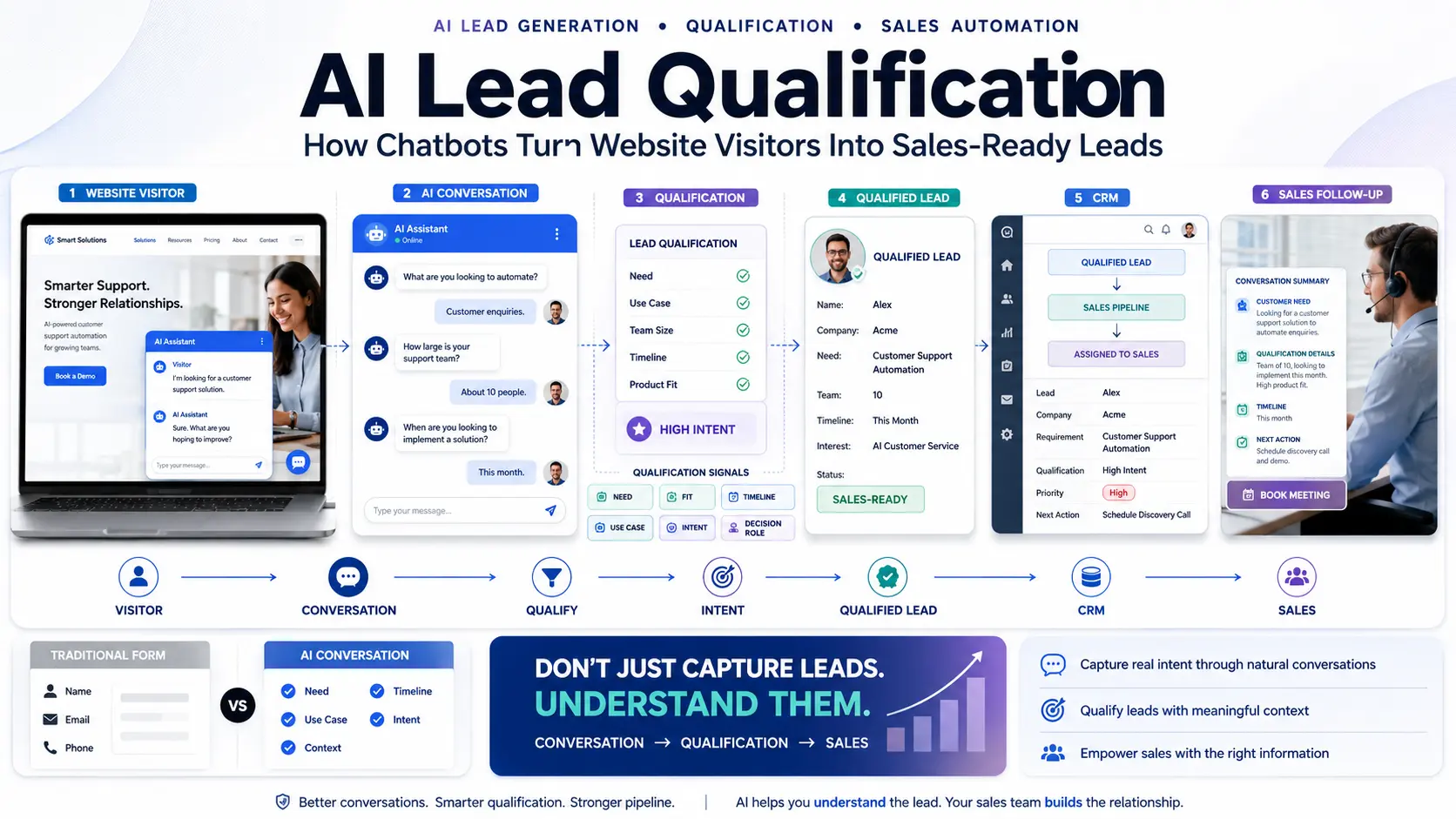
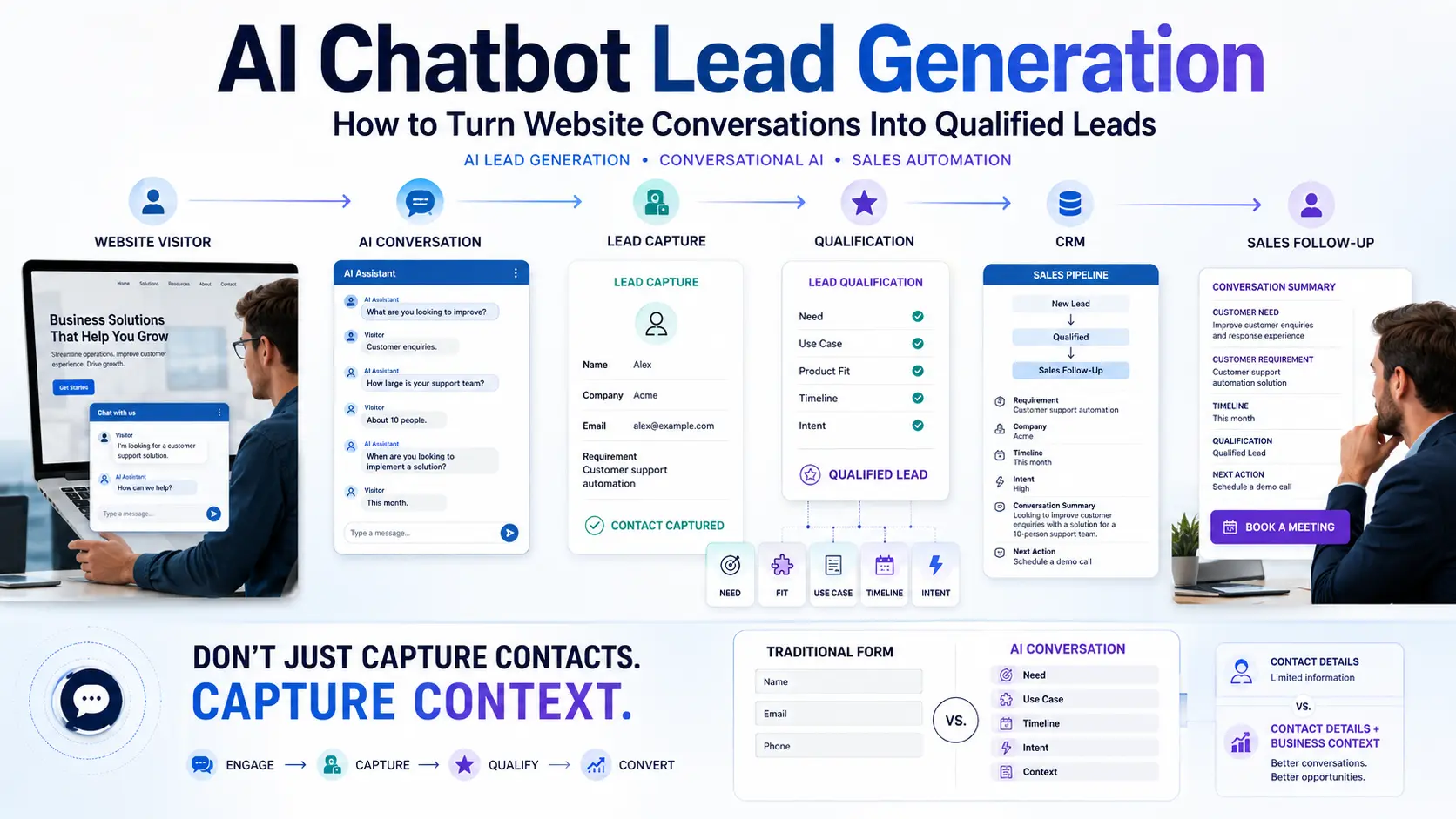
VISITOR ↓ CONVERSATION ↓ UNDERSTANDING ↓ LEAD CAPTURE ↓ QUALIFICATION
Conversational lead generation is about creating a genuinely useful interaction, not simply pasting a generic chatbot on a website.
Quick Answer: What is AI chatbot lead generation?
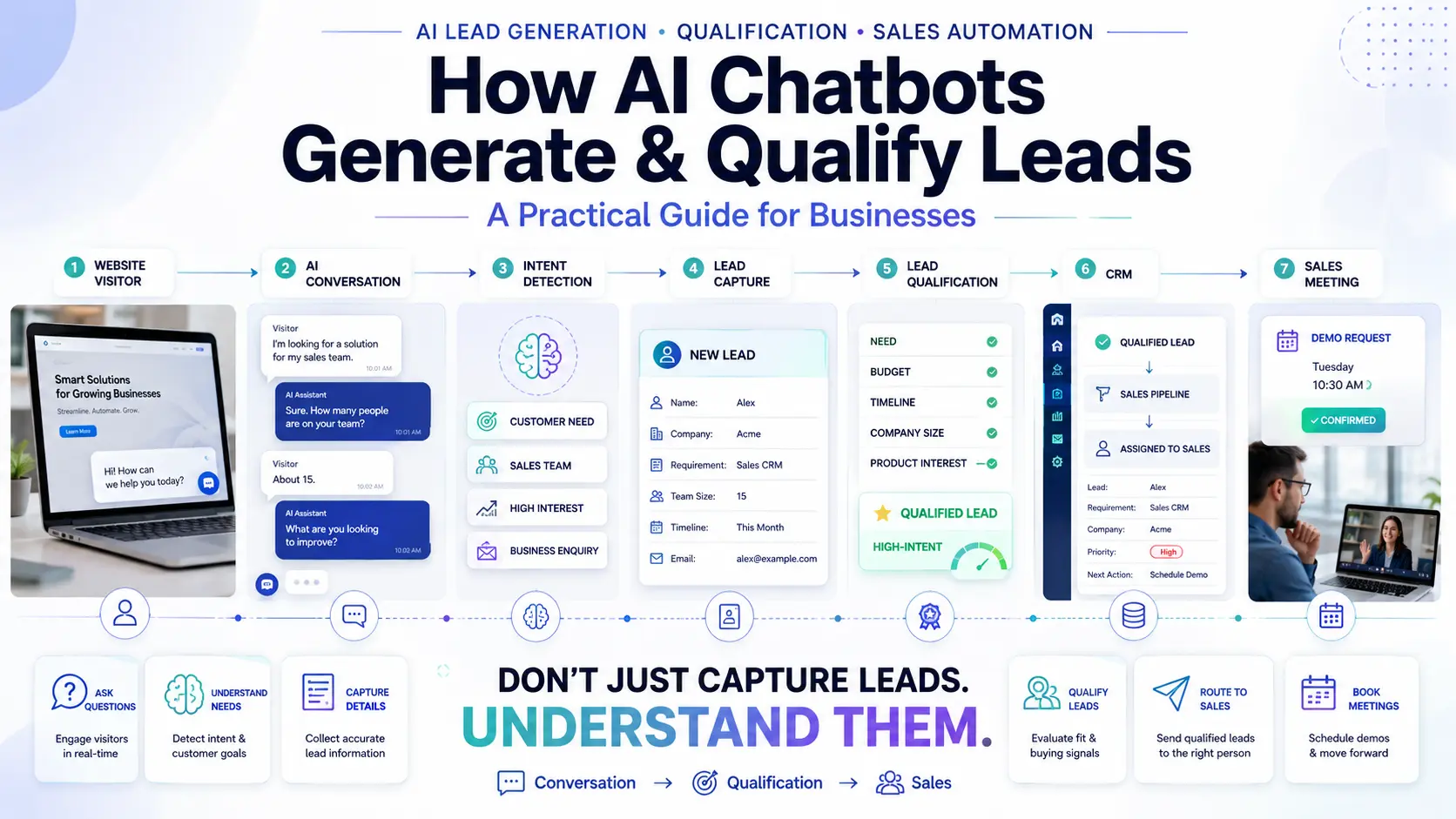
AI chatbot lead generation uses conversational AI to engage website visitors, answer questions, collect relevant information, identify potential buying intent, and route promising prospects into a sales workflow.
VISITOR → CONVERSATION → LEAD CAPTURE → QUALIFICATION → CRM → SALES
AI does not magically make every visitor a qualified lead. The quality of the result depends heavily on proper conversation design, strict qualification criteria, CRM integration, and timely human follow-up.
What Is AI Chatbot Lead Generation?
At its core, AI chatbot lead generation is the use of conversational AI on a digital channel to engage potential customers and smoothly move appropriate visitors toward a lead or sales action.
Depending on your business model, these actions might include:
- • Requesting information
- • Asking for a quote
- • Booking a meeting
- • Requesting a demo
- • Starting an enquiry
- • Providing contact details
- • Speaking with sales
It is crucial to differentiate between a CHATBOT AS SUPPORT (resolving issues for existing customers) and a CHATBOT AS LEAD-GENERATION ASSISTANT (identifying sales opportunities). A well-designed system can do both, but lead generation requires specific intent-capture workflows.
How AI Chatbot Lead Generation Works
The complete conversational funnel looks like this:
Step 1 — Visitor Arrives
The visitor lands on a high-intent page, such as a Pricing or Product page.
Step 2 — Conversation Begins
The chatbot provides a contextual, useful prompt rather than a generic greeting.
Example: "Looking for information about our enterprise services?"
Step 3 — Visitor Explains Their Need
The visitor responds naturally in their own words, explaining their core problem.
Step 4 — AI Understands Intent
The chatbot analyzes the input to determine what the visitor is trying to accomplish (support vs. sales).
Step 5 — AI Provides Relevant Information
The chatbot answers the immediate question, building trust before demanding an email address.
Step 6 — Lead Capture
If appropriate, the chatbot asks for contact information to continue the interaction or send materials.
Step 7 — Qualification
The chatbot asks 2-3 relevant questions to determine if the lead is a fit for the sales team.
Step 8 — CRM
The captured data and conversational context are pushed automatically into the sales workflow.
Step 9 — Human Follow-Up
A sales representative reviews the CRM data and takes over the relationship.
Lead Capture vs Lead Qualification
This distinction must be crystal clear: Not every captured lead is qualified.
As we discussed in our guide on AI Lead Qualification, a chatbot can capture hundreds of contacts but still provide zero value if the sales team cannot determine which opportunities actually matter.
| Lead Capture | Lead Qualification |
|---|---|
| Collects contact details | Evaluates potential fit |
| Name | Need |
| Use case | |
| Phone | Timeline |
| Company | Buying intent |
| Creates a contact | Helps prioritize the opportunity |
How Chatbots Capture Leads
There are two primary ways an AI chatbot collects lead information:
1. Contact Forms Inside Chat
The AI presents a mini-form within the chat window, asking for Name, Email, Phone, and Company all at once. This is faster but introduces friction similar to a landing page.
2. Conversational Capture
The information is collected naturally, piece by piece, during the flow of the conversation.
AI: "What company are you with?"
Visitor: "Acme Technologies."
...later in the conversation...
AI: "Would you like us to send the pricing information directly to your email?"
Conversational capture feels much more natural, but businesses must be careful to avoid collecting unnecessary information that drags the conversation out.
What Information Should a Lead Generation Chatbot Collect?
Do not ask for a phone number if your sales team only communicates via email. The goal is to collect ENOUGH INFORMATION TO MOVE THE CONVERSATION FORWARD, not to collect as much data as humanly possible.
| Information | Why It Can Matter |
|---|---|
| Name | Identification and personalization |
| Asynchronous follow-up | |
| Phone | Direct contact where appropriate |
| Company | Business context and account routing |
| Requirement | Understand the core need |
| Use case | Determine product fit |
| Timeline | Dictates sales urgency and priority |
| Team size | Assists in qualification and tiering |
| Existing solution | Provides competitive context |
| Preferred next step | Determines the immediate sales action |
How AI Chatbots Identify Buying Intent
Conversational AI uses Natural Language Processing (NLP) to parse the underlying intent of a message. It watches for conversational signals.
- Low Intent: "I'm just researching." (Provide value, capture email for a newsletter).
- Medium Intent: "What features do you offer?" (Explain capabilities, guide to a product page).
- High Intent: "Can I get a demo?" (Trigger the meeting scheduler).
- Very Specific Intent: "Can someone discuss pricing and implementation?" (Route immediately to a senior sales rep).
While AI cannot perfectly determine intent every time, interpreting these signals alongside the visitor's stated Timeline and Fit allows businesses to categorize opportunities highly effectively.
How AI Chatbots Qualify Leads
To generate a lead that a sales team will actually pursue, the bot must qualify it.
LEAD CAPTURE ↓ QUALIFICATION ↓ SALES PRIORITY
As detailed in our AI Lead Qualification guide, common criteria include: Need, Fit, Use case, Timeline, Company size, Decision role, and Budget (where appropriate). The specific qualification criteria should be explicitly defined by the business based on historical sales data.
Example AI Lead Generation Conversation
Here is what a value-driven conversation looks like in practice:
Visitor
"I need help improving customer support on our website."
AI
"What type of customer questions do you receive most often?"
Visitor
"Mostly product and pricing questions."
AI
"Approximately how many enquiries does your team handle each month?"
Visitor
"Several hundred."
AI
"Are you currently using a CRM or support platform?"
Visitor
"Yes."
AI
"When would you like to improve the current process?"
Visitor
"This month."
AI
"Thanks. I can connect you with our team to discuss your requirements. Would you like to book a conversation?"
Look at what has been captured: Need, Use case, Volume, Existing system, Timeline, and Intent. This is exponentially more valuable to a salesperson than simply receiving a form submission alert.
Why Conversational Lead Generation is Different
Traditional forms are not obsolete. They remain excellent for simple lead capture (like downloading a report). But for engaging potential buyers, compare the two:
| Traditional Form | AI Conversation |
|---|---|
| Fixed fields | Dynamic questions |
| Same experience for all | Adapts to responses |
| Contact information only | Contact + deep context |
| Visitor chooses what to type | AI can subtly guide the conversation |
| Static interaction | Interactive dialogue |
| Limited qualification ability | Native qualification support |
What Makes a Good Lead Generation Chatbot?
- Relevant Conversation: Do not ask questions unrelated to the visitor's expressed intent.
- Useful Answers: The chatbot must provide actual value and information before demanding contact details.
- Short Qualification: Do not create a long, tedious interrogation. Ask the core questions and move on.
- Clear Next Step: Guide the user to a specific outcome: book a meeting, request a quote, or contact sales.
- Human Handoff: Provide a seamless way to reach a live person if the bot gets stuck.
- CRM Integration: Ensure the data actually moves into the sales workflow.
AI Chatbot Lead Generation and CRM
A chatbot that does not connect to a CRM is just a toy.
Without CRM:
CHATBOT ↓ LEAD ↓ MANUAL COPY / PASTE
With CRM:
CHATBOT ↓ LEAD + CONTEXT ↓ CRM ↓ SALES OWNER ↓ FOLLOW-UP
To maximize efficiency, businesses must route this structured data into a Pre-Sales CRM. The CRM integration must include the full qualification context, not just a bare-bones Name and Email file.
What Should Be Sent to the CRM?
| Data | Example |
|---|---|
| Name | Alex |
| Company | Acme Technologies |
| alex@example.com | |
| Requirement | Customer support automation |
| Use case | Website enquiries and ticketing |
| Timeline | This month |
| Qualification | Meets defined criteria |
| Intent | High-interest enquiry |
| Conversation summary | [AI Generated Short Summary] |
| Next action | Sales discovery call |
AI Lead Generation Across Different Business Models
- B2B Enterprise: Focus on business need, company size, team, use case, timeline, and decision role.
- SaaS: Focus on product interest, existing software stack, team size, and demo intent.
- Professional Services: Focus on specific project requirements, scope, timeline, and booking consultations.
- E-commerce: Focus on product discovery, specific product questions, and immediate purchase intent.
- High-Consideration Products: Focus on requirements, fit, timeline, budget ranges, and in-depth consultation booking.
Benefits of AI Chatbot Lead Generation
- Captures More Context: Sales teams receive detailed background information, not just a blank form submission.
- Engages Visitors: Visitors can get their questions answered before deciding whether to provide their contact details.
- Supports Qualification: Pre-defined questions filter out bad fits before they reach human sales reps.
- Reduces Manual Work: Sales teams receive structured, actionable data automatically.
- Helps Prioritize Leads: High-intent, well-qualified leads can be fast-tracked to senior executives.
- Connects Marketing and Sales: Transforms passive website traffic into active sales workflows.
What AI Chatbot Lead Generation Cannot Do
Be wary of vendors promising magic. AI cannot guarantee qualified leads, force sales, or magically increase conversions if the underlying product is weak.
AI has limitations:
- It cannot fix poor website content or a lack of traffic.
- It cannot succeed with weak qualification criteria.
- It can misinterpret ambiguous intents.
- It requires continuous monitoring to fix bad conversation design.
- It fails entirely if the CRM integration is broken or sales reps ignore the follow-up.
As McKinsey frequently notes, AI is an augmentation tool, not a complete replacement for human relationship-building.
Common AI Lead Generation Mistakes
- Asking for contact information too early: Provide value first.
- Asking too many questions: Keep it concise.
- Making the chatbot too sales-focused: Don't act like a spammy pop-up.
- Providing poor answers: Ensure the AI is trained on accurate business knowledge.
- Collecting unnecessary data: Ask only what you need.
- Sending every lead to sales: Filter the noise.
- Not defining qualification criteria: Tell the AI what a "good" lead looks like.
- Not integrating CRM: Manual data entry kills momentum.
- Losing conversation context: Send the transcript to sales.
- Ignoring human handoff: Provide an escape hatch to a live agent.
- Measuring only the number of leads: Measure quality, not volume.
- Not reviewing conversations: Read chat logs to improve the bot.
How to Build an AI Chatbot Lead Generation Workflow
Follow this practical framework:
IDEAL CUSTOMER
↓
VISITOR QUESTIONS
↓
CONVERSATION DESIGN
↓
LEAD CAPTURE
↓
QUALIFICATION LOGIC
↓
CRM INTEGRATION
↓
SALES HANDOFF
How to Measure AI Chatbot Lead Generation
MORE LEADS ≠ BETTER LEADS
Do not focus solely on volume. The most important measurement is whether the chatbot is creating useful sales opportunities. Track:
- • Conversations started
- • Engaged conversations
- • Leads captured
- • Qualification completion rate
- • Total qualified leads
- • Meetings booked
- • CRM-created leads
- • Sales-accepted leads
- • Sales opportunities generated
- • Final sales conversion
- • Human handoff rates
- • Unresolved questions
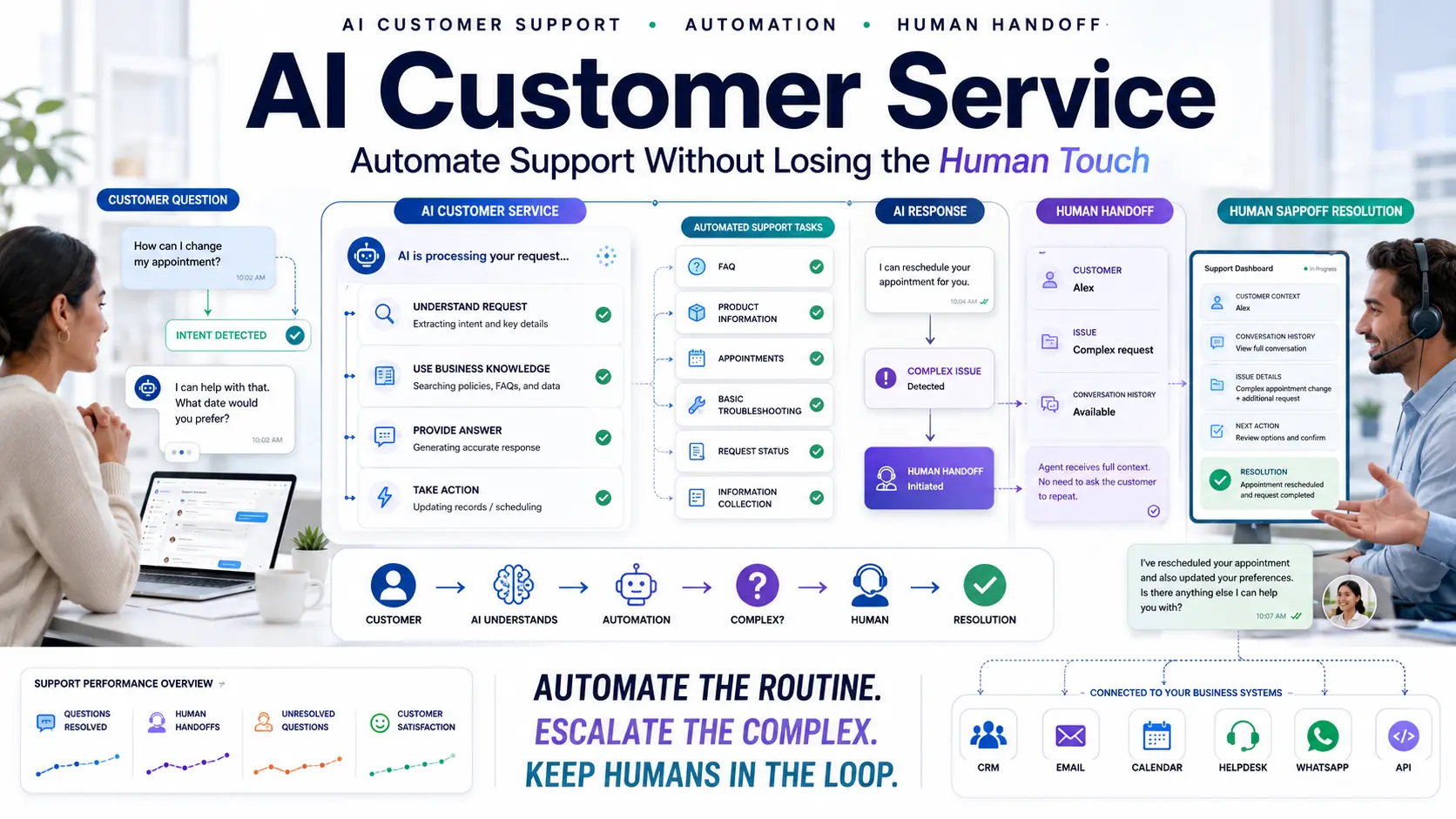
AI Chatbot Lead Generation vs AI Customer Service
| AI Customer Service | AI Lead Generation |
|---|---|
| Resolves customer questions | Identifies sales opportunities |
| Support-focused | Sales-focused |
| FAQ handling | Lead capture |
| Troubleshooting | Qualification |
| Issue resolution | Meeting booking |
| Human support handoff | Sales handoff |
Working Together
Both functions can exist in the same website assistant. For more on the support side, read our guide to AI Customer Service.
A good website AI assistant does not force every conversation into a sales funnel. It first helps the visitor. Then, when appropriate, it identifies the business opportunity:
VISITOR QUESTION ↓ AI ANSWERS ↓ BUYING INTENT DETECTED ↓ LEAD CAPTURE ↓ QUALIFICATION ↓ CRM ↓ SALES
How Quillive Can Support AI Chatbot Lead Generation
Quillive is a dedicated AI Website Assistant designed to manage both the support and lead generation pipeline.
Businesses can evaluate Quillive to engage website visitors, answer questions using trained business information, capture leads conversationally, qualify enquiries, and book appointments. By passing conversations to human team members seamlessly and supporting broader sales workflows, it acts as a reliable first-line extension of your sales operation.
AI Chatbot Lead Generation Checklist
Strategy & Conversation
- Define ideal customer
- Define lead criteria
- Define desired sales action
- Useful opening message
- Relevant answers
- Natural conversation
- Clear next steps
Capture & Qualification
- Name & Email
- Phone & Company
- Requirement / Timeline
- Need / Fit
- Use case / Intent
Sales & Measurement
- CRM integration
- Lead routing
- Conversation summary
- Human handoff
- Appointment booking
- Leads / Qualified leads
- Meetings
- Sales acceptance
- Opportunities
- Conversion
Frequently Asked Questions
What is AI chatbot lead generation?
Using conversational AI to engage website visitors, collect relevant information, and identify potential buying intent to route prospects into a sales workflow.
How do AI chatbots generate leads?
By starting useful conversations, answering initial questions, and seamlessly requesting contact details from interested visitors.
Can AI chatbots capture leads?
Yes, either by presenting a short form within the chat window or by collecting details conversationally.
Can AI chatbots qualify leads?
Yes, by asking predefined questions about a prospect's budget, timeline, and product needs before notifying sales.
What is a lead generation chatbot?
A digital assistant optimized specifically to identify sales opportunities and capture contact data.
What is the difference between lead capture and lead qualification?
Capture collects the contact details; qualification evaluates whether the prospect is actually a good fit for your business.
How do chatbots identify buying intent?
By using Natural Language Processing (NLP) to parse conversational signals like "Can I get a demo?" or "What does this cost?"
What questions should a lead generation chatbot ask?
Keep it to the core elements: Need, Timeline, and specific Fit (like company size or industry).
Can an AI chatbot integrate with a CRM?
Yes, integration is essential to push structured data and conversation transcripts directly to sales teams.
Can chatbots book sales meetings?
Yes, if connected to calendar software, they can confirm appointments with qualified leads instantly.
Can AI chatbots generate B2B leads?
Yes, this is one of their strongest use cases, particularly when capturing complex project requirements.
Can AI chatbots qualify website visitors?
Yes, filtering out unqualified traffic allows sales reps to focus only on high-value conversations.
Are AI chatbots better than lead forms?
For top-of-funnel engagement, yes. They reduce friction and create an interactive experience.
How much does an AI lead generation chatbot cost?
It varies widely based on usage, CRM integration complexity, and the level of AI capability provided.
What features should a lead generation chatbot have?
Native CRM integrations, dynamic routing, conversational capture, meeting booking, and seamless human handoff.
Can AI chatbots replace sales teams?
No. They augment sales teams by handling discovery, but human reps are required to close deals.
How accurate is AI lead qualification?
Highly accurate if the business provides strict criteria, though human review is always beneficial.
What industries can use AI chatbot lead generation?
SaaS, B2B services, real estate, healthcare, education, and high-ticket e-commerce benefit the most.
How do you measure chatbot lead generation?
Track the qualification rate, meetings booked, and the final sales conversion rate of the captured leads.
What is conversational lead generation?
Gathering prospect information through a real-time dialogue rather than a static landing page form.
How do you build an AI lead generation workflow?
Define your ideal customer, identify common visitor questions, design the chat flow, and connect your CRM.
Conclusion
AI chatbot lead generation is not simply about adding a chat bubble to a website. A successful system should help businesses understand which conversations are worth pursuing and give sales teams the context they need to close deals faster.
The real workflow is: ENGAGE ↓ UNDERSTAND ↓ CAPTURE ↓ QUALIFY ↓ ROUTE ↓ FOLLOW UP
By connecting these elements properly, you stop losing high-intent visitors and start filling your pipeline with actionable opportunities. To see how conversational lead generation can streamline your website, review how the Quillive AI Website Assistant operates.

Quillnext Team
The Quillnext Team builds advanced conversational AI solutions that help businesses automate customer support, capture leads, and scale operations efficiently.
Visit Quillnext