Quick Answer: What is AI Customer Support?
AI customer support uses artificial intelligence to automate and enhance customer service interactions. Through a customer support chatbot, businesses can instantly answer frequently asked questions, assist with order tracking, and troubleshoot issues 24/7 without human intervention. Businesses adopt AI to drastically reduce wait times, cut operational costs, and relieve human agents from repetitive tasks. By handling the bulk of routine inquiries, AI empowers support teams to focus on complex, high-value problem solving, resulting in higher customer satisfaction and better service scalability.
Introduction
In the digital era, the baseline for customer expectations has fundamentally shifted. When a customer has a question about a product, a billing issue, or an order delay, they no longer tolerate waiting 24 to 48 hours for an email response. They expect immediate answers, personalized support, and consistent service across websites, messaging apps, and social media.
Businesses relying solely on manual support teams or outdated ticketing systems often struggle to keep up. Slow response times lead to negative reviews, repetitive questions cause severe agent burnout, and scaling a support team to meet growing ticket volumes quickly becomes financially unsustainable.
Enter AI customer support. By leveraging Conversational AI, businesses are transforming their help desks from reactive, overworked call centers into proactive, automated engines that deliver faster, smarter customer service around the clock.
What is AI Customer Support?
AI customer service refers to the deployment of artificial intelligence technologies—specifically Natural Language Processing (NLP) and machine learning—to assist, engage, and resolve customer issues automatically.
- Conversational AI & Chatbots: Intelligent virtual assistants that live on your website or within your app, capable of understanding human intent, parsing complex sentences, and delivering accurate answers.
- AI Knowledge Bases: Systems that ingest your company's PDFs, past support tickets, and website URLs so the AI "learns" the business intimately.
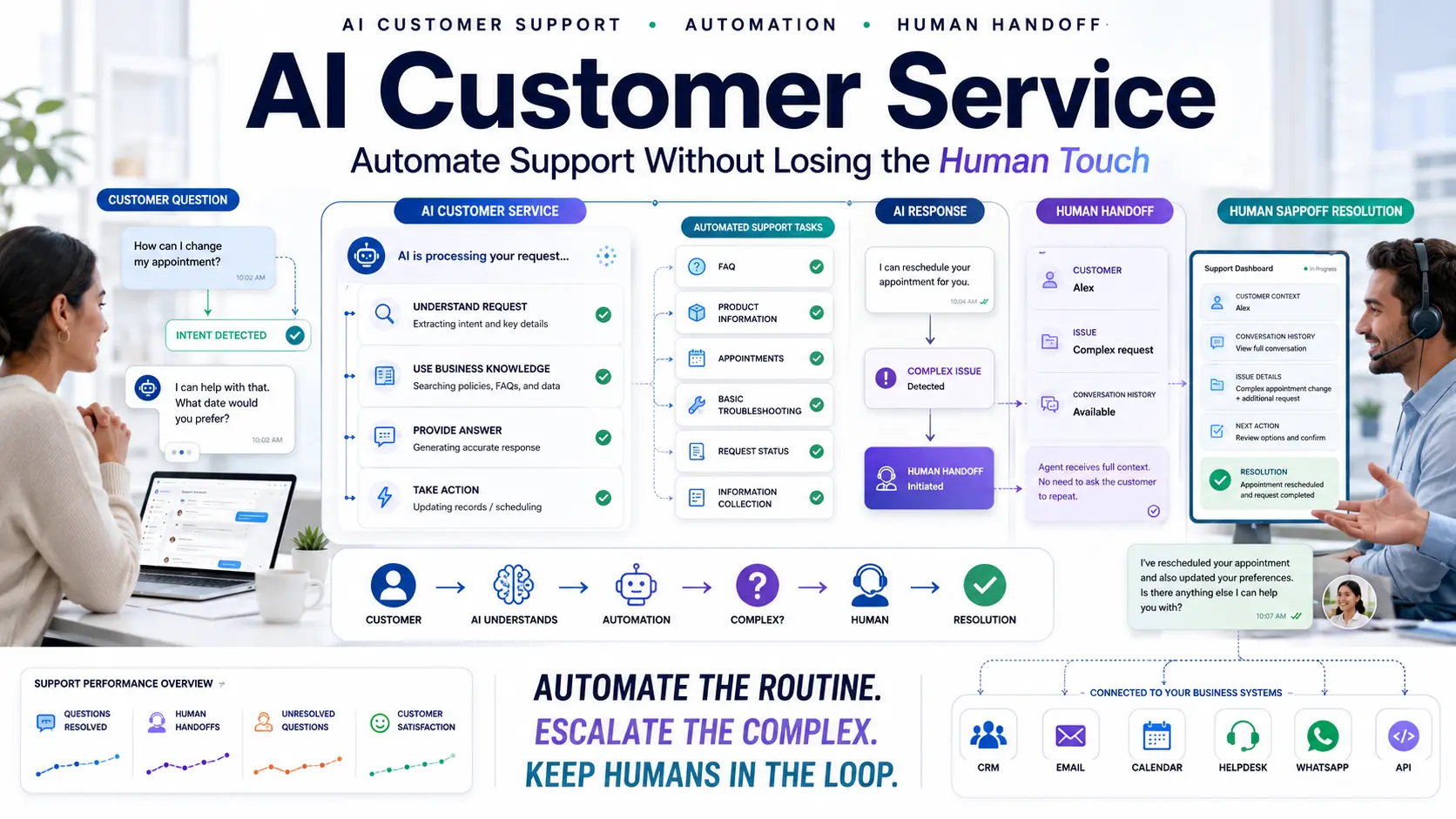
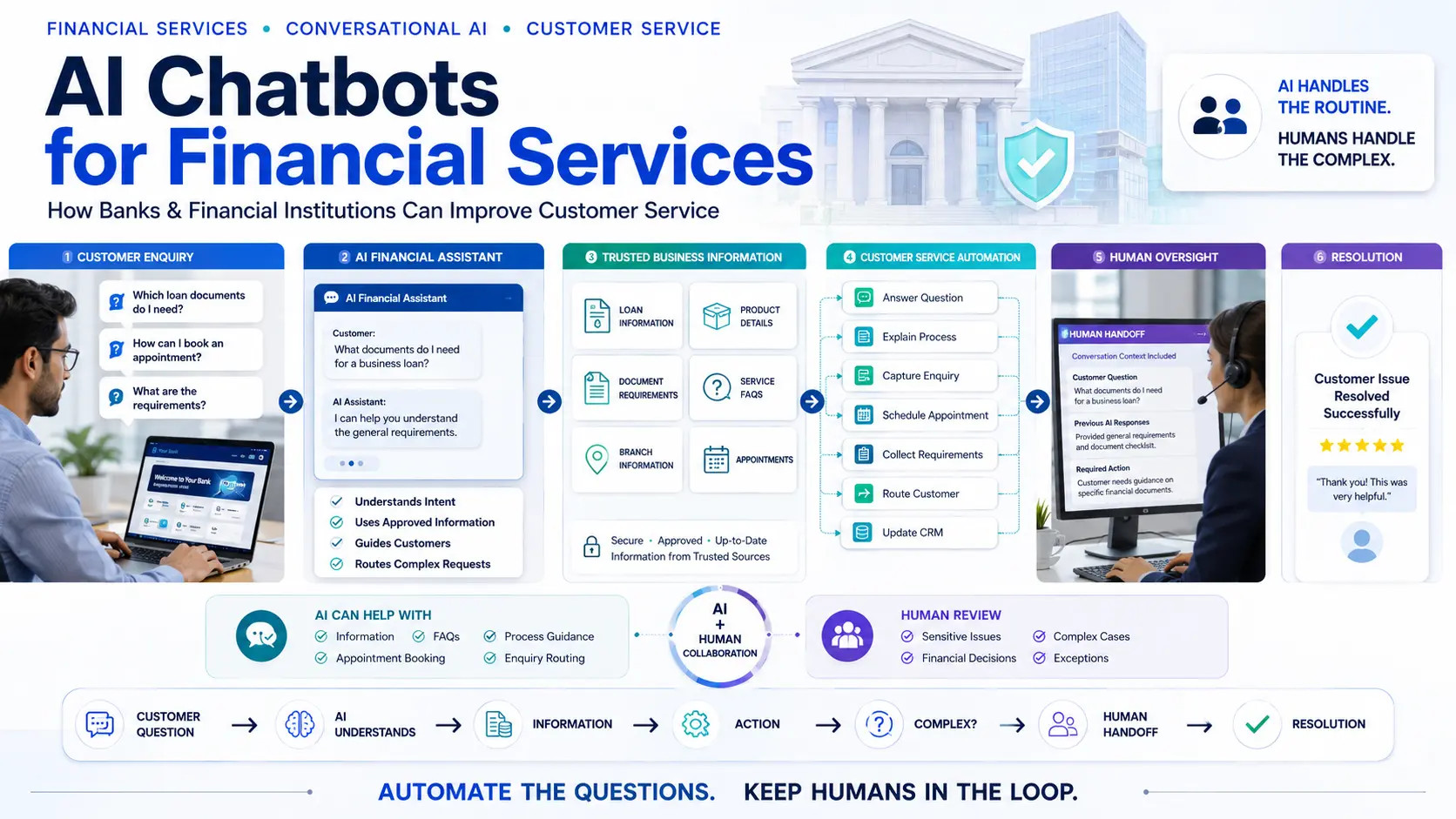
- Human Handoff: Crucially, modern AI support is not designed to trap users. When the AI encounters an emotionally charged customer or a complex technical bug, it instantly escalates the chat to a human agent with full context.
Example: A user types, "I need to change the shipping address for order #4099." An AI support bot identifies the intent, securely authenticates the user, accesses the order database via API, updates the address, and confirms the change—all in three seconds.
Why Traditional Customer Support Struggles
As a business scales, the traditional support model—relying entirely on human agents typing out responses—breaks down due to basic mathematics.
- Long Response Times: Customers often wait in queues for 30+ minutes on phone lines or days via email. According to Zendesk, slow response times are the leading cause of customer churn.
- Limited Business Hours: Traditional teams log off at 5:00 PM on Friday. Modern consumers shop and require support 24/7.
- Agent Burnout: Support agents spend up to 80% of their day answering the exact same 15 questions ("Where is my order?", "How do I reset my password?"). This causes high turnover rates.
- Rising Support Costs: When ticket volume doubles, a traditional company must double its headcount, making customer service a massive cost center.
How AI Customer Support Works
To understand how customer service automation functions, let's examine the standard workflow of a resolved ticket.
The Automated Resolution Workflow
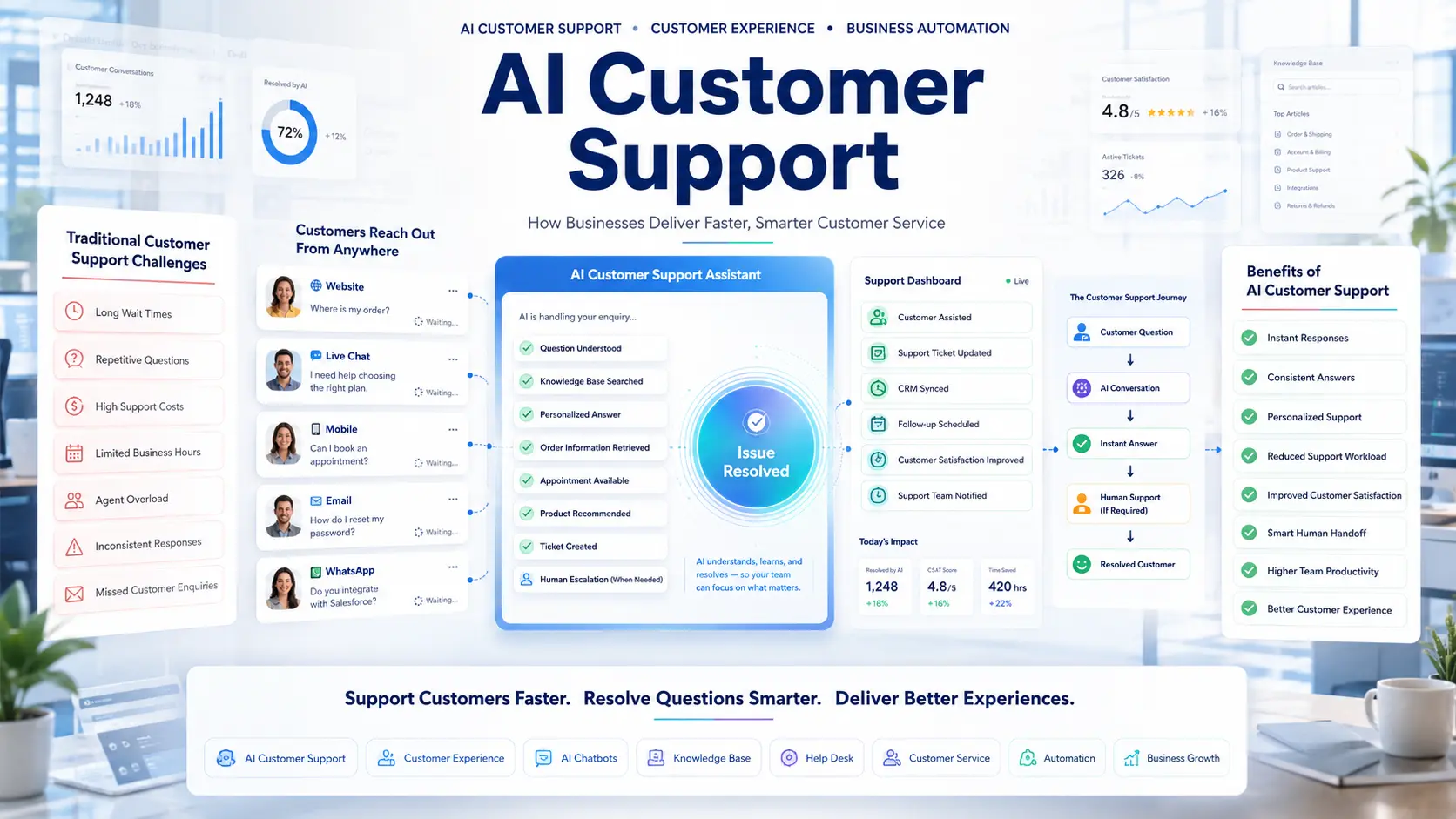
- Customer Question: A user clicks the chat widget on an e-commerce site at 2:00 AM and types, "What is your return policy for shoes?"
- AI Chatbot Intercepts: The AI instantly recognizes the intent (Return Policy) and the specific entity (Shoes).
- Knowledge Base Search: The AI queries the company's ingested knowledge base for the exact policy regarding footwear returns.
- Personalized Response: The AI replies, "For shoes, you have 30 days to return them provided they are unworn. Would you like me to start a return for your last order?"
- Issue Resolution: The customer clicks "Yes," and the AI generates a return shipping label via an API integration.
- Human Escalation (If required): If the user replied, "They arrived damaged," the AI would tag the conversation as "Damage Claim" and route it to the morning support queue.
- Satisfied Customer: The issue is resolved instantly without a human agent ever touching the ticket.
AI Customer Support vs Traditional Customer Support
When comparing an AI help desk to a human-only team, the differences in operational efficiency become clear.
| Feature | Traditional Support | AI Customer Support |
|---|---|---|
| Availability | Business hours only. | 24/7/365. |
| Response Time | Minutes to hours. | Instant (Milliseconds). |
| Scalability | Requires hiring more staff. | Infinite concurrency. |
| Cost | High overhead (Salaries). | Low (SaaS subscription). |
| Consistency | Varies by agent mood/training. | 100% adherence to guidelines. |
| Human Involvement | Handles 100% of tickets. | Only handles complex 20%. |
Benefits of AI Customer Support
Implementing an AI chatbot for customer support yields immense benefits across the organization.
- Faster Response Times: By eliminating queues, businesses see CSAT (Customer Satisfaction) scores rise significantly.
- Lower Operational Costs: AI deflects up to 80% of tier-1 support tickets, drastically reducing the cost-per-resolution.
- Higher Team Productivity: Agents are liberated from answering "What are your business hours?" and can focus on saving at-risk accounts or upselling.
- Improved Customer Retention: According to HubSpot, 90% of customers rate an "immediate" response as essential when they have a customer service question.
Common Customer Support Tasks AI Can Automate
AI is best utilized for high-volume, low-complexity tasks. It excels at:
Automated Tasks
- Frequently asked questions (Shipping, policies)
- Order status tracking & updates
- Appointment & demo booking
- Lead qualification & data capture
- Password resets & basic account info
Tasks for Human Agents
- Complex technical troubleshooting
- Handling angry or frustrated customers
- Bespoke billing disputes
- High-ticket enterprise sales closing
- Custom, out-of-policy refund requests
Industry Use Cases
How different sectors apply customer support automation software:
E-commerce
Retailers use e-commerce chatbots to automate WISMO (Where Is My Order) inquiries, process seamless returns, and recommend complementary products during the checkout flow.
Healthcare
Clinics deploy healthcare AI assistants to handle secure appointment bookings, answer pre-operation FAQs, and route urgent medical queries to nurses.
SaaS
Software companies rely on SaaS chatbots to guide users through complex product onboarding, link to API documentation, and deflect basic technical support tickets.
Education
Universities use educational bots to field thousands of repetitive questions regarding admissions criteria, tuition deadlines, and campus housing during peak enrollment periods.
Financial Services
Banks use fintech bots to assist users in checking account balances, locating ATMs, or understanding loan interest rates safely and securely.
How to Implement AI Customer Support
Transitioning to an AI-first support model is straightforward if approached methodically:
- Identify Repetitive Questions: Analyze your last 1,000 support tickets. What are the top 5 questions customers ask?
- Build a Knowledge Base: Ensure your website FAQs and internal documents are accurate and up-to-date.
- Train the AI Assistant: Upload your knowledge base into an AI platform so it can learn your specific business logic.
- Connect Business Systems: Integrate the AI with your CRM (e.g., Salesforce, Zendesk) or order management system (e.g., Shopify).
- Configure Escalation Rules: Define exactly when the bot should say, "Let me get a human to help you with this."
- Monitor Analytics: Review the dashboard weekly to see which questions the AI failed to answer, and update the knowledge base accordingly.
Common Mistakes Businesses Make
No Human Escalation
Trapping a frustrated customer in an endless loop with a bot that doesn't understand them will destroy your brand reputation.
Trying to Automate Everything
AI should handle the easy 80%, not the complex 20%. Do not use AI to handle delicate tasks like final account cancellations.
Ignoring Analytics
If 40% of users are dropping off at a specific question, the knowledge base must be updated. AI requires ongoing supervision.
Lack of Personalization
An AI that talks like a rigid robot is off-putting. Use modern NLP platforms to ensure the bot uses a conversational, empathetic tone.
How Quillive Helps Businesses Improve Customer Support
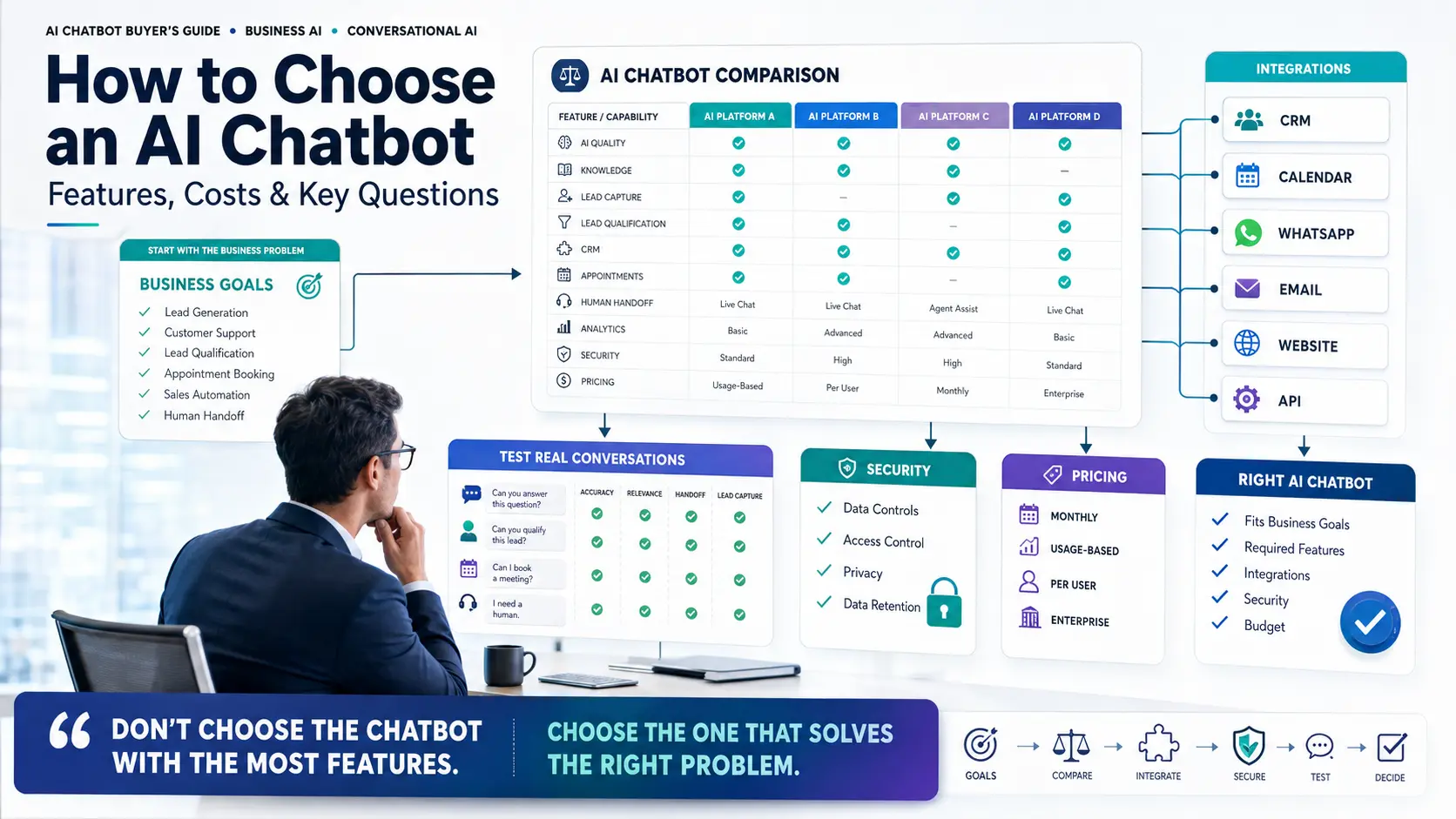
Choosing the right AI virtual assistant for customer support dictates whether your automation strategy succeeds or fails. Quillive is built precisely for this purpose.
Instead of forcing businesses to build rigid decision trees, Quillive uses advanced generative AI to ingest your website data, FAQs, and documents. It acts as a highly knowledgeable, instantaneous extension of your support team.
- Instant Answers: Quillive resolves common customer inquiries instantly, 24/7.
- Seamless Handoff: When an issue is too complex, Quillive seamlessly transfers the chat to a live human agent inside your Sales CRM or support dashboard.
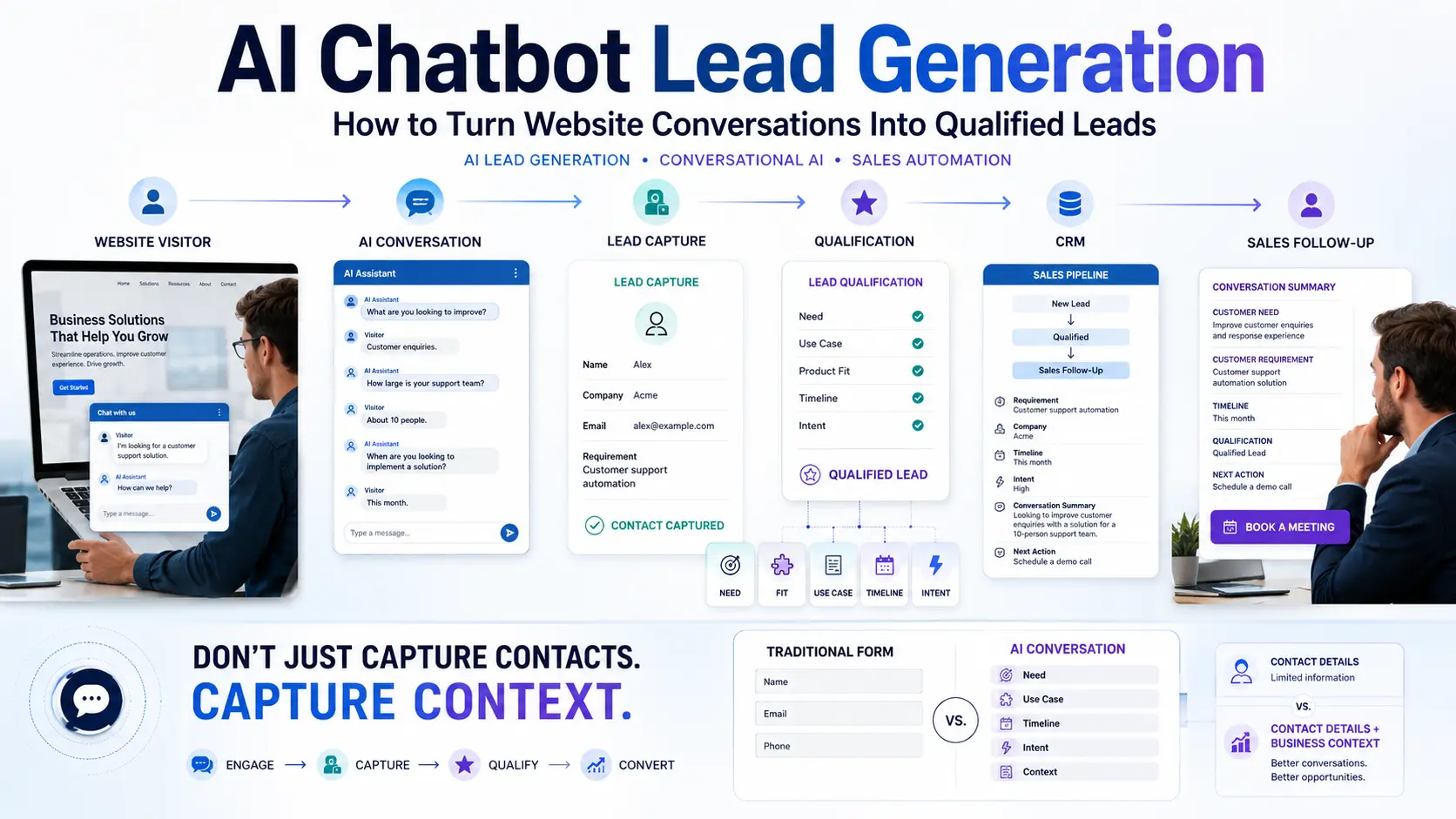
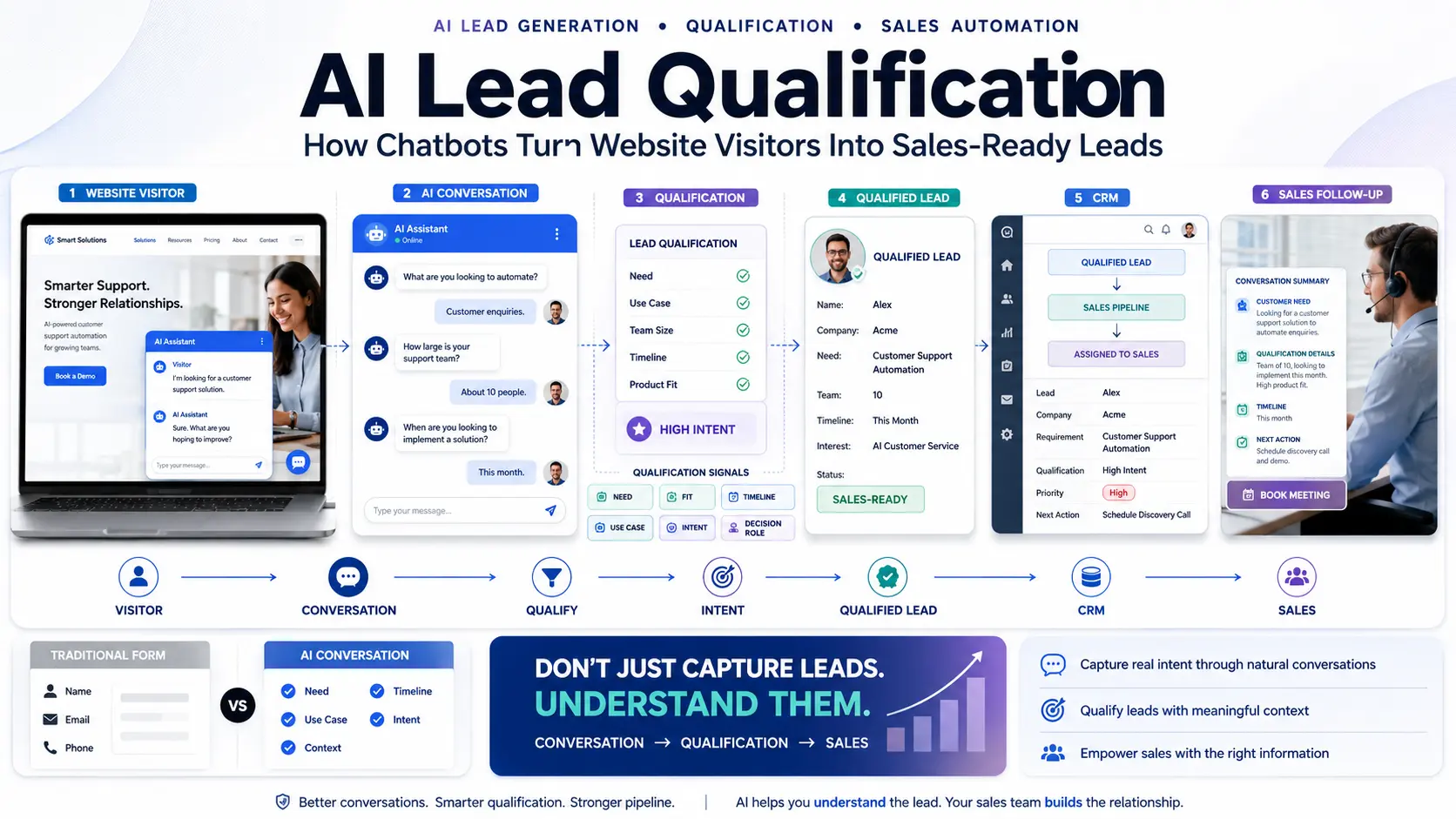
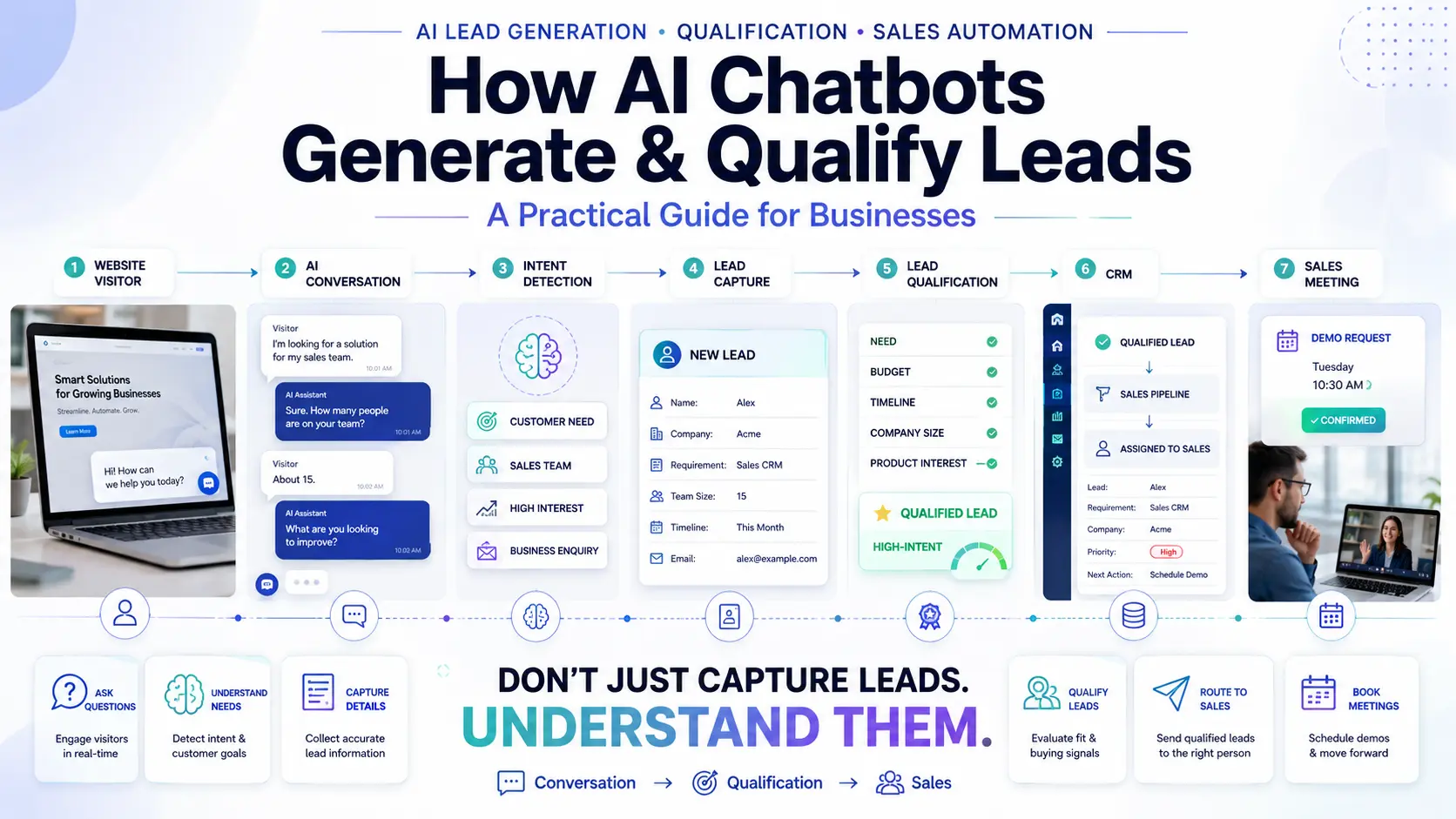
- Lead Qualification: Beyond just support, Quillive acts proactively to capture enquiries and qualify leads, bridging the gap between support and sales.
- Analytics Insights: The platform shows you exactly what your customers are asking for, revealing gaps in your product or documentation.
Frequently Asked Questions
What is AI customer support?
The use of artificial intelligence to automate, assist, and resolve customer inquiries instantly without human intervention.
How does AI improve customer service?
It eliminates wait times, provides 24/7 availability, ensures consistent answers, and handles repetitive tasks so humans can focus on complex issues.
Can AI replace customer support agents?
No. AI is designed to augment support teams by handling tier-1 tickets, not to replace the empathy and problem-solving skills of human agents.
What are the benefits of AI customer support?
Benefits include significantly reduced operational costs, higher customer satisfaction, scalable service during peak hours, and reduced agent burnout.
Which industries benefit most?
E-commerce, SaaS, healthcare, education, travel, and financial services benefit immensely due to high volumes of routine inquiries.
How accurate are AI chatbots?
Highly accurate, provided they are securely grounded on a company's approved knowledge base rather than general internet data.
Can AI integrate with CRM?
Yes. Platforms like Quillive seamlessly integrate with Salesforce, Zendesk, and QuillCRM to log chats and create tickets automatically.
Can AI answer FAQs?
Yes, answering Frequently Asked Questions is the primary use case and immediate ROI driver for implementing an AI chatbot.
What happens when AI cannot answer?
The AI gracefully escalates the conversation, apologizing and instantly transferring the chat—and full transcript—to an available human agent.
How much does AI customer support cost?
SaaS models make it highly affordable, often starting at under $100 a month, which is a fraction of the cost of a single support employee.
Is conversational AI hard to set up?
No. Modern platforms like Quillive simply require you to paste your website URL or upload PDFs to train the bot automatically in minutes.
Does AI work on mobile devices?
Yes, modern AI chat widgets are fully responsive and often provide a better support experience on mobile than navigating dense FAQ pages.
Can AI support multiple languages?
Yes, AI can instantly translate and understand dozens of languages, allowing local businesses to offer global support.
Will AI steal my customers' data?
Enterprise AI tools are compliant with strict data privacy laws like GDPR and SOC2, ensuring customer data is secure.
Do customers hate talking to bots?
Customers hate *bad* bots that trap them. They love intelligent AI that solves their problem in 5 seconds instead of waiting on hold for 20 minutes.
Can an AI process a refund?
Yes, if integrated with an order management system like Shopify, an AI can process refunds based on predefined business rules.
Can AI detect customer frustration?
Yes, through sentiment analysis, advanced AI can detect angry keywords and immediately trigger a priority escalation to a human manager.
How does AI improve employee retention?
By automating the monotonous tasks (like resetting passwords), human agents get to do more fulfilling, complex problem-solving work, reducing turnover.
Is AI only for large enterprises?
Not anymore. SaaS pricing models have democratized AI, allowing small businesses and startups to offer Fortune 500-level customer support.
Can AI support handle proactive outreach?
Yes, chatbots can proactively pop up on specific pages (like the checkout page) to offer assistance if a user seems stuck.
What is ticket deflection?
Ticket deflection is the metric of how many customer issues the AI resolved entirely on its own, preventing a human ticket from being created.
How do I measure the ROI of AI support?
Track your ticket deflection rate, the decrease in average response time, and the overall improvement in CSAT or NPS scores.
Can I customize the AI's personality?
Yes, you can instruct the AI to adopt your brand's voice—whether that is formal and corporate, or casual and witty.
Can AI recommend products?
Yes, during a support interaction, if an AI solves an issue, it can naturally suggest an upsell or complementary product.
What happens if my knowledge base changes?
Most AI platforms automatically re-crawl your website periodically, ensuring the bot always has the most up-to-date pricing and policy info.
Conclusion
The era of customer support acting merely as a reactive cost center is over. By implementing AI customer support, businesses can transform their service operations into a proactive, scalable, and highly efficient engine.
Automation does not mean losing the human touch; it means reserving human empathy for the complex issues that truly require it. By allowing AI to handle the repetitive inquiries, businesses can deliver immediate gratification to customers while dramatically reducing operational overhead.
As customer expectations continue to rise, adopting Quillive or similar conversational AI tools ensures your business is equipped to provide faster, smarter, and infinitely scalable customer service.

Quillnext Team
The Quillnext Team builds advanced conversational AI solutions that help businesses automate customer support, capture leads, and scale operations efficiently.
Visit Quillnext